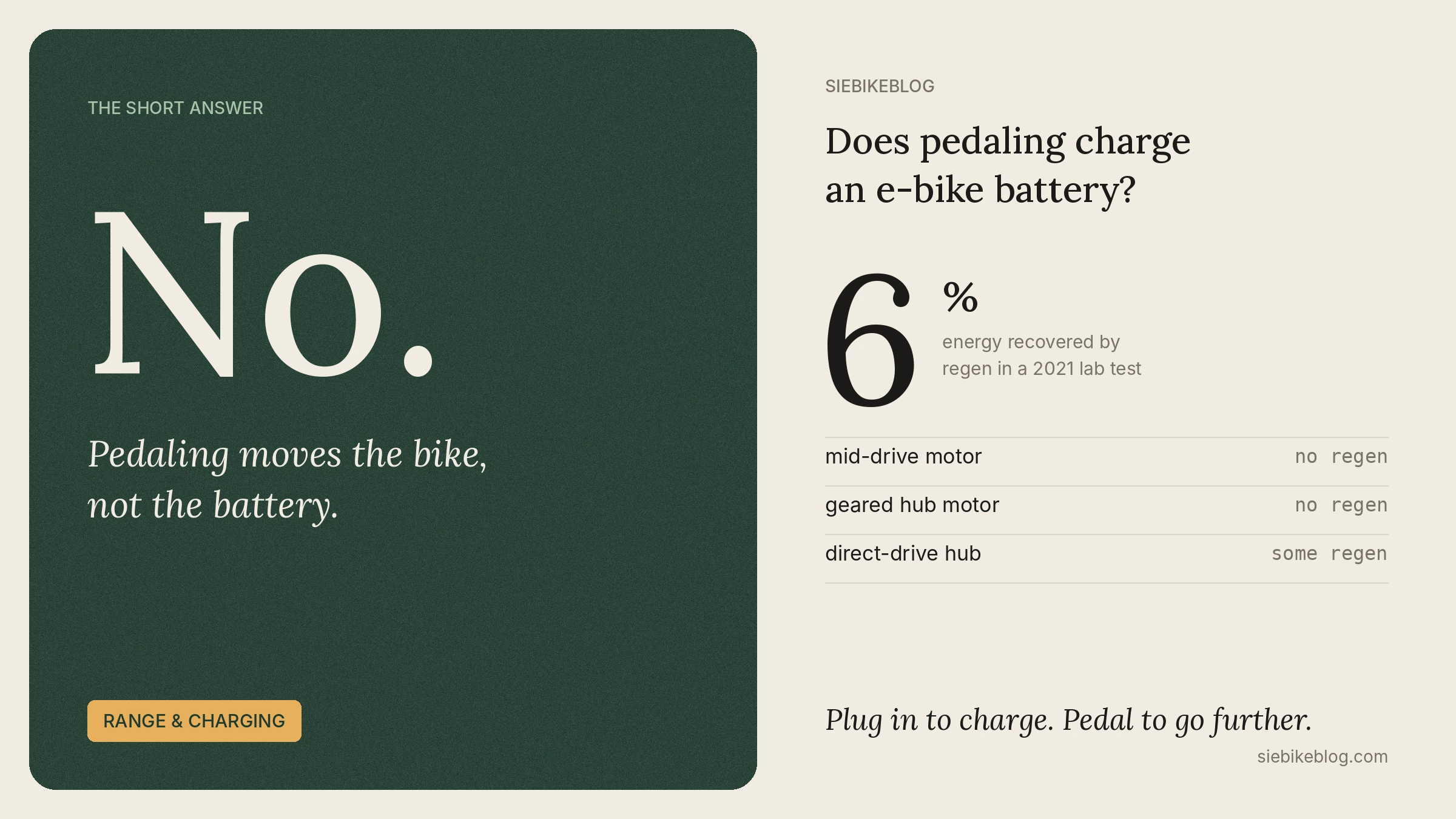
Quick Answer: Does pedaling charge an e-bike battery? On almost all e-bikes, no. Pedaling moves the bike but doesn’t send power back to the battery. A small number of e-bikes with direct-drive hub motors can recover some energy through regenerative braking, but it usually adds only a few percent of range.
Key Takeaways
- Mid-drive and geared hub motors can’t recharge the battery, because a freewheel or clutch disconnects the motor when you coast.
- Only direct-drive hub motors with a regen-capable controller can turn motion back into electricity.
- A 2021 lab study on an e-bike hub motor measured about 6% energy recovery from regenerative braking.
- Even a strong rider pedaling into a generator would need around 5 hours to fill a 500 Wh battery.
- Plugging in remains the only practical way to charge; riding habits matter far more for range.
It seems logical: you’re pedaling, the motor is connected to the wheel, so why shouldn’t the battery top itself up? Many new riders expect an e-bike to work like a hybrid car. In practice, almost none do.
This guide explains why pedaling doesn’t charge most e-bikes, which bikes can recover energy, how much range regenerative braking really adds, and what actually stretches your battery further.
Table of Contents
- Why can’t most e-bikes charge while you pedal?
- Which e-bikes have regenerative braking?
- How much range does regenerative braking add?
- Is regen worth choosing an e-bike for?
- What extends e-bike range instead?
- Frequently asked questions
Why Can’t Most E-Bikes Charge While You Pedal?
Because on most e-bikes the motor isn’t connected to the wheel in a way that lets it work as a generator. Any electric motor can, in principle, make electricity when it’s turned by an outside force. The U.S. Department of Energy’s Alternative Fuels Data Center notes that some electric vehicles use “motor generators” that handle both drive and regeneration. Most e-bikes are simply built without that second job.
How your bike’s motor is built decides whether regeneration is possible:
| Motor type | Where it sits | Can it regenerate? | Why |
|---|---|---|---|
| Mid-drive | At the pedals (crank) | No | A freewheel in the rear hub lets the wheel spin without turning the motor, and the drive unit isn’t designed to generate |
| Geared hub | In the wheel hub | No | An internal clutch disengages the motor whenever you coast |
| Direct-drive hub | In the wheel hub | Sometimes | The motor is always linked to the wheel, so it can generate if the controller supports regen |
Mid-drives and geared hubs are what most commuter, mountain and folding e-bikes use, because they’re lighter and give more torque for their size. That’s why the answer for most riders is a flat no.
There’s also a simpler reason pedaling itself can’t fill the battery: a fit rider sustains roughly 100 watts for an hour or more. Even if every watt went into the battery, a 500 Wh pack would take about 5 hours of hard pedaling to fill, and you’d have gone nowhere. Energy recovery only makes sense from braking and descending, which is where regen comes in.
Which E-Bikes Have Regenerative Braking?
Only e-bikes with a direct-drive hub motor and a controller built for regen can recover energy. You’ll mostly find it on some heavier city, cargo and long-range touring bikes, and on DIY conversion kits that pair a direct-drive hub with a programmable controller.
Here’s what happens when regen kicks in:
- You squeeze the brake lever or ease off the throttle. A sensor in the lever (or a regen setting) tells the controller to switch modes.
- The motor becomes a generator. The spinning wheel turns the motor’s magnets past its coils, creating current.
- The controller sends that current to the battery. At the same time, the motor resists the wheel, which slows the bike down.
- Your mechanical brakes do the rest. Regen braking is gentle, so you still need normal brakes for hard stops.
To check whether a bike has it, look in the spec sheet for “regenerative braking,” “regen,” or “energy recovery,” and confirm the motor is described as direct-drive or gearless. If the listing says mid-drive or geared hub, it won’t regenerate, whatever the marketing says about “charging while you ride.”
How Much Range Does Regenerative Braking Add?
Usually only a few percent, and close to nothing on flat roads with few stops. A 2021 study on regenerative braking of an e-bicycle hub motor measured an energy recovery of 6.37% at its test speed, with recovery improving at higher motor speeds.
The physics explains why the number stays small. You can only recover energy you would otherwise waste in the brakes, and on a bicycle that isn’t much. Here are two worked estimates for a rider and bike weighing 100 kg together with a 500 Wh battery:
Energy (Wh) = Mass (kg) × 9.81 × Height (m) ÷ 3,600
| Situation | Energy available | Recovered at ~30% | Share of a 500 Wh battery |
|---|---|---|---|
| One stop from 25 km/h | about 0.7 Wh | about 0.2 Wh | 0.04% |
| 50 city stops | about 33 Wh | about 10 Wh | about 2% |
| One 300 m descent | about 82 Wh | about 25 Wh | about 5% |
Estimates. The 30% recovery rate is an assumption; air drag, rolling resistance and motor losses take much of the energy before regen can catch it. Stopping energy uses ½ × mass × speed² instead of the height formula.
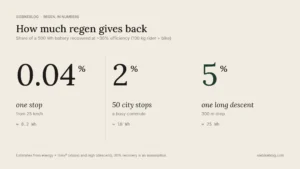
Regen helps most on long descents and barely at all on single stops.
So regen helps most on hilly routes with long braking descents, and least on flat commutes. On a typical mixed ride, expect the low single digits, in line with the lab result above. That’s useful, but it’s a bonus rather than a way to charge the battery.
Is Regenerative Braking Worth Choosing an E-Bike For?
For most riders, no. Regen is a nice extra on a direct-drive bike, but the motor type it requires brings trade-offs that usually matter more than a few percent of range.
| Direct-drive hub with regen | Mid-drive or geared hub | |
|---|---|---|
| Energy recovery | A few percent, more on hilly routes | None |
| Motor weight | Heavier | Lighter |
| Pedaling with the motor off | Noticeable drag from the magnets | Coasts freely |
| Hill-climbing torque | Lower at low speed | Higher (especially mid-drives) |
| Brake pad wear | Lower, because regen does some braking | Normal |
| Moving parts in the motor | Fewer, so very durable | Gears or clutch can wear |
Regen makes the most sense if you ride a heavy cargo or city bike in a hilly area, brake often on long descents, and rarely pedal with the motor switched off. If your rides are mostly flat, or you want a light bike that feels natural without assist, a mid-drive or geared hub will serve you better, and you’ll get more range from simply choosing a larger battery.
What Extends E-Bike Range Instead?
Your own pedaling is the biggest range booster, just not in the way people expect. When you pedal harder, the motor supplies less power, so the battery drains more slowly. These habits make a far bigger difference than regen:
- Use a lower assist level. Eco or tour mode can cut consumption sharply compared with turbo; most e-bikes use roughly 12–20 Wh per mile on mixed riding, as explained in our guide to what Ah and Wh mean on an e-bike battery.
- Pedal at a steady cadence. Shifting to an easier gear before hills keeps the motor out of its least efficient, high-current zone.
- Keep tires at the right pressure. Soft tires add rolling resistance on every mile.
- Go easy on the throttle. Throttle-only riding uses the battery with no help from your legs.
- Start with a healthy battery. A pack that has lost capacity gives less range no matter how you ride; see how long an e-bike battery lasts for the habits that slow that loss.
For the charging itself, a wall socket is still the only practical option. Our guide to charging an e-bike battery overnight covers how long it takes and how to do it safely.
Frequently Asked Questions
Does an e-bike charge when going downhill? Only if it has a direct-drive hub with regen. Mid-drive and geared hub e-bikes just coast; the battery level stays the same.
Can I add regenerative braking to my e-bike? Not to a mid-drive or geared hub bike. You’d need to swap to a direct-drive hub motor and a regen-capable controller, which usually costs more than the energy it saves.
Can a dynamo hub charge an e-bike battery? No, not usefully. Bicycle dynamos produce only a few watts, which is enough for lights or a phone but tiny next to a 500 Wh battery.
Can I charge an e-bike battery with a solar panel? Yes, with a properly matched solar charging setup, but a portable panel adds only a modest amount per day. It works best as a backup for touring, not a replacement for the wall charger.
Does regenerative braking damage the battery? Not when the system is designed for it. The controller limits charging current, and regen pulses are small compared with a normal wall charge.
Why does my e-bike feel heavy to pedal with the motor off? If it has a direct-drive hub, the motor’s magnets create a slight drag. Geared hubs and mid-drives coast much more freely.
The Bottom Line
Pedaling doesn’t charge an e-bike battery on mid-drive or geared hub bikes, and regen on direct-drive hubs adds only a few percent of range. Plug in to charge, and use a lower assist level when you want the battery to go further.

Leave a Reply