
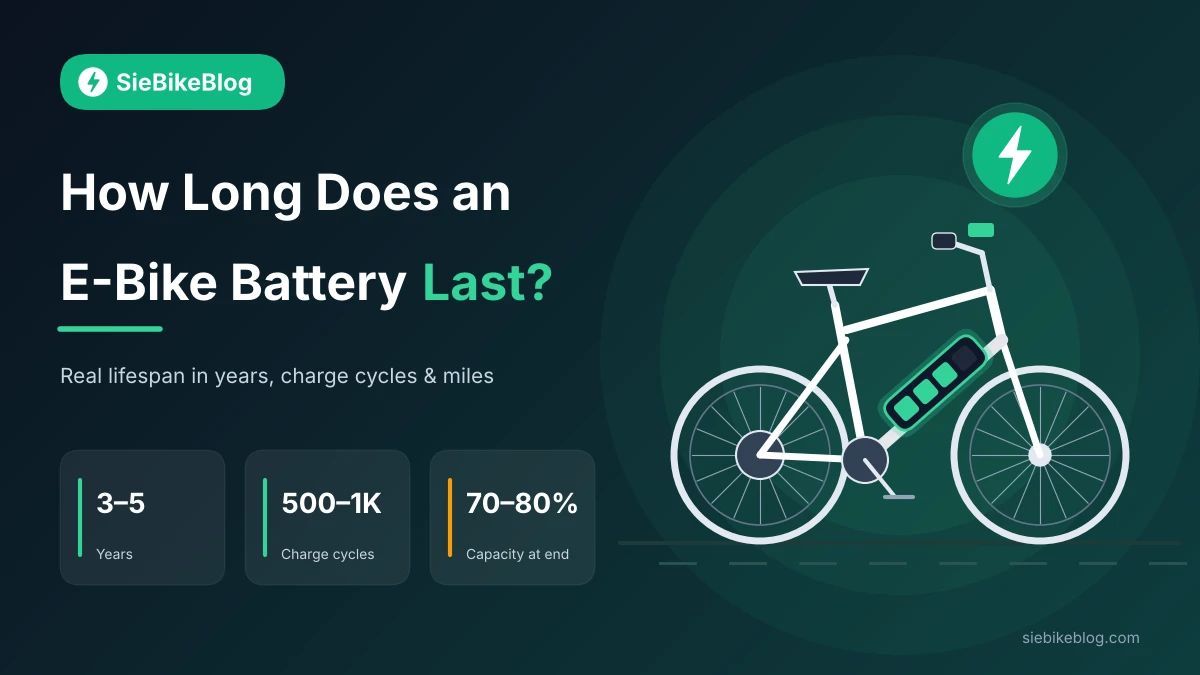
Quick Answer: Most e-bike batteries last 3 to 5 years, or roughly 500 to 1,000 full charge cycles, before capacity drops to about 70–80% of new. The battery doesn’t die suddenly; range shrinks gradually. Heat, storing it at 100%, and running it to empty wear it out fastest.
Key Takeaways
- Count cycles, not birthdays. A pack ridden daily can wear out in 2–3 years, while a weekend-only pack that’s stored well can pass 5 years.
- For a typical 500 Wh battery, 500–1,000 cycles works out to roughly 10,000–30,000 miles of riding (an estimate; your terrain and assist level move it a lot).
- Lab data from Battery University shows shallow use pays off: draining only 40% per ride can deliver about three times the cycles of draining to zero.
- A full battery sitting in a hot garage ages faster than a half-full one ridden every day.
- A replacement pack often costs $500 or more, so a few habits that add a year or two are worth real money.
If you’re asking how long an e-bike battery lasts, you probably want one of two numbers: how many years before you need a new pack, or how far it’ll take you before that happens. This guide gives both, then shows exactly which habits push your battery toward the short end or the long end of that range.
The numbers below come from battery lab testing and manufacturer care guidance rather than guesswork, so you can match them to the way you ride.
Table of Contents
- How long does an e-bike battery last in years, cycles and miles?
- What does a “worn out” e-bike battery mean?
- What shortens an e-bike battery’s life the most?
- Which charging habits make an e-bike battery last longer?
- How should you store an e-bike battery?
- How can you estimate your own battery’s lifespan?
- How do you know when an e-bike battery needs replacing?
- Frequently asked questions
How Long Does an E-Bike Battery Last in Years, Cycles and Miles?
A quality lithium-ion e-bike battery lasts about 3 to 5 years, which equals roughly 500 to 1,000 full charge cycles. One cycle means using 100% of the battery’s capacity, whether in one long ride or several short ones. After that point, the pack still works but holds noticeably less charge.
Years are the number most riders ask about, but cycles are what wear the cells. Two people with the same battery can end up years apart:
| Rider type | Typical use | Full cycles per year | Expected lifespan |
|---|---|---|---|
| Daily commuter | 15–20 miles a day, 5 days a week | 150–250 | 2–4 years |
| Regular rider | 3–4 rides a week | 80–150 | 4–6 years |
| Weekend rider | 1–2 rides a week | 30–60 | 5+ years (age becomes the limit) |
| Delivery / cargo | 40+ miles a day, heavy loads | 300+ | 1.5–3 years |
Estimates assume a 500 Wh battery averaging 25–40 miles per full charge and a 500–1,000 cycle rating.
Notice the weekend rider: even with few cycles, a lithium-ion pack keeps aging on the shelf. That’s why a barely used five-year-old battery can still disappoint. The next section explains what “worn out” looks like in practice.
What Does a “Worn Out” E-Bike Battery Mean?
An e-bike battery counts as worn out when it holds about 70–80% of its original capacity. It doesn’t stop working at that point. You just get less range from every charge: a pack that once gave you 40 miles might give 28–32.
Lithium-ion cells lose capacity a little with every cycle and every month of age. In a lab test published by Battery University, eleven new lithium-polymer packs cycled from full to empty fell from 88–94% capacity to 73–84% after only 250 full cycles. That’s harsh, full-depth use, but it shows how steady and predictable the fade is.
What this means for you:
- Around 80% capacity: most riders first notice the shorter range here. Many manufacturers rate cycle life to this point.
- Around 70% capacity: range loss starts to limit longer rides, and the pack may sag on hills.
- Below 60%: voltage drops fast under load, the display may jump from two bars to zero, and replacement makes sense.
So the real question isn’t when the battery dies. It’s when the remaining range stops covering your rides, and that depends heavily on the habits below.
What Shortens an E-Bike Battery’s Life the Most?
Heat combined with a full charge does the most damage, more than riding itself. Battery University notes that a lithium-ion cell sitting above 30°C (86°F) at full charge can age faster than one that’s cycled regularly. Here are the main causes, ranked roughly by impact.
Heat and storing at 100%
This pairing is the biggest silent killer. Battery University’s storage data shows how much capacity a lithium-ion cell keeps after a year at different temperatures and charge levels:
| Storage temperature | Stored at 40% charge | Stored at 100% charge |
|---|---|---|
| 0°C (32°F) | 98% after 1 year | 94% after 1 year |
| 25°C (77°F) | 96% after 1 year | 80% after 1 year |
| 40°C (104°F) | 85% after 1 year | 65% after 1 year |
| 60°C (140°F) | 75% after 1 year | 60% after just 3 months |
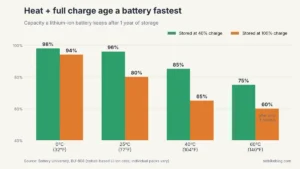
Storing at partial charge keeps far more capacity, especially in heat.
Read the 25°C row again. At ordinary room temperature, a pack left full for a year lost about 20% of its capacity, while one kept near 40% lost only 4%. A car boot or sunny balcony in summer pushes the numbers toward the bottom rows.
Draining to empty on every ride
Deep discharges stress the cells more than shallow ones. Riding until the motor cuts out, then leaving the pack empty for days, is a common way to lose a battery early. Lithium-ion has no “memory effect,” so there’s no benefit to running it flat.
High current draw
Full throttle, the top assist mode, steep climbs and heavy cargo all pull more current, which heats the cells from the inside. A rider who lives in turbo mode will reach the end of the cycle rating sooner than one who uses eco or tour mode on flat roads.
Cell quality and charging in the cold
Packs built with name-brand cells (Samsung, LG, Panasonic, Molicel) and a good battery management system (BMS) age more evenly. If you want a refresher on how the battery, motor and controller work together, our e-bike parts overview covers each one. Charging below freezing is also harmful: Bosch advises charging and storing the battery at room temperature in winter and fitting it to the bike just before the ride, as stated in its battery care guidance.
The good news is that each of these causes has a simple fix, and most of them come down to how you charge.
Which Charging Habits Make an E-Bike Battery Last Longer?
Charge little and often, and avoid both extremes. Keeping your battery roughly between 20% and 80–90% for everyday riding, unplugging once it’s done, and charging at room temperature can multiply the number of cycles you get compared with draining it flat and leaving it on 100%.
The effect of shallow use is easy to underestimate. Battery University’s cycle-life figures show how many cycles a cell delivers before it falls to 70% capacity, depending on how deep each discharge goes:
| How much you use per charge | Cycles (NMC cells, most e-bikes) | Cycles (LiFePO4 cells) |
|---|---|---|
| 100% (full to empty) | ~300 | ~600 |
| 80% | ~400 | ~900 |
| 60% | ~600 | ~1,500 |
| 40% | ~1,000 | ~3,000 |
| 20% | ~2,000 | ~9,000 |
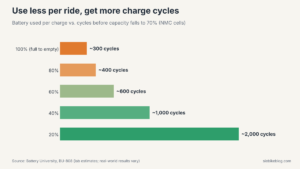
Shallow charging can more than triple a battery’s cycle count.
Shallow cycles cost more total charges but deliver far more total energy over the pack’s life. Here’s how to turn that into a routine:
- Top up after shorter rides. Plugging in at 50% is better for the cells than waiting for one bar.
- Stop at 80–90% when you don’t need full range. Bosch battery care advice recommends this range for the longest service life. Charge to 100% only before a long ride, and ride soon after.
- Unplug when charging finishes. Don’t leave the pack sitting on the charger overnight, day after day.
- Let a hot battery cool first. After a long climb or a summer ride, wait 30 minutes before charging.
- Use the original charger. A mismatched or cheap charger can overcharge cells or bypass protections.
If your bike’s app or display offers a “battery care” or charge-limit mode, switch it on. It does the 80% rule for you. Charging is only half the picture, though; what you do between rides matters just as much.
How Should You Store an E-Bike Battery Between Rides and Over Winter?
Store it indoors, dry, at about 15–20°C (59–68°F), and at a partial charge of 30–60%. That combination slows calendar aging, which keeps eating capacity even when the bike isn’t moving.
Day-to-day storage
- Keep the bike out of direct sun. A dark frame in a parked car or on a balcony can heat the pack well above 40°C.
- If the bike lives in a cold shed or garage, take the battery inside.
- Don’t store the pack fully charged “so it’s ready.” Charge it the evening before a ride instead.
Storing for a month or longer
- Ride or charge until the pack sits at about 40–60% (two or three bars on most five-bar indicators).
- Remove it from the bike and keep it indoors, away from heaters and windows.
- Check the level every 4–8 weeks. Lithium-ion slowly self-discharges, and the BMS draws a small current too.
- Top it back up to around 50% if it drops below two bars. A pack left at zero for months may refuse to wake up.
Bosch lists storage above 30°C and long periods at full or empty charge among the things to avoid, in its battery care advice. If you’ve followed these habits for a few years, you’ll want a rough idea of how much life is left. That’s what the next section works out.
How Can You Estimate Your Own Battery’s Lifespan?
Divide the battery’s rated cycles by the number of full cycles you use each year. Full cycles per year equals your yearly mileage divided by the miles you get from one full charge.
\text{Years} \approx \frac{\text{Rated cycles}}{\text{Yearly miles} \div \text{Miles per full charge}}You’ll find the cycle rating in your battery’s manual or spec sheet. If it isn’t listed, use 500 for a budget pack and 800–1,000 for a branded one.
Example 1: the city commuter
- Rides 20 miles a day, 250 days a year = 5,000 miles
- Gets about 30 miles per charge in mid assist = ~167 full cycles a year
- Battery rated for 600 cycles → 600 ÷ 167 ≈ 3.6 years
Example 2: the weekend rider
- Rides 2,000 miles a year
- Gets about 40 miles per charge in eco mode = 50 full cycles a year
- Battery rated for 800 cycles → 800 ÷ 50 = 16 years on paper
The weekend rider won’t get 16 years. Lithium-ion keeps aging with time, so even lightly used packs rarely go far past 5–7 years in real-world use, which is why storage habits matter so much for low-mileage riders. Use the formula as a ceiling, then knock off time for heat, full-charge storage and heavy throttle use.
Once your estimate says you’re close to the limit, the battery itself will start giving you signals.
How Do You Know When an E-Bike Battery Needs Replacing?
Replace it when the range no longer covers your normal rides, or right away if the pack shows any physical damage. Range loss is a convenience problem; swelling, heat or smell is a safety problem.
Gradual signs (plan a replacement)
- Your usual route now needs a mid-ride or end-of-day top-up it didn’t need before.
- The charge display drops in jumps, for example from three bars to one on a single climb.
- The motor cuts out on hills while the display still shows charge left.
- Charging finishes much faster than it used to, because there’s less capacity to fill.
A simple home test: fully charge, ride your usual loop in the same assist mode, and note the miles until the first low-battery warning. Compare that with what you got when the bike was new. A drop of 25–30% means you’re near the end of useful life. Dealers for systems like Bosch can also read the pack’s cycle count and health with their diagnostic software.
Warning signs (stop using it now)
- The case is swollen, cracked or dented
- The pack gets hot to the touch while charging or resting
- A sweet, chemical or burning smell
- The bike was submerged or the battery took a hard drop
If you see any of these, stop charging it, keep it away from anything flammable, and contact the manufacturer or a battery recycler.
Replace, rebuild or buy cheap?
| Option | What it is | Best for | Watch out for |
|---|---|---|---|
| Original replacement | Same brand and model pack | Most riders; keeps warranty and full system compatibility | Highest price |
| Professional rebuild | Specialist fits new cells into your old case | Discontinued packs, older bikes | Usually voids warranty; quality depends on the shop |
| Cheap generic pack | Unbranded online battery | Rarely worth it | Unknown cells, weak BMS, higher fire risk |
Certification matters here. UL Solutions explains that UL 2849 tests the whole e-bike electrical system together, including the battery and charger, for fire safety. The U.S. Consumer Product Safety Commission has also urged manufacturers to follow these UL standards. When you buy a new pack, look for UL 2849 or UL 2271 certification, or EN 50604-1 in Europe, and avoid packs with no listed standard.
Frequently Asked Questions
Does a bigger battery last more years? Usually, yes. A 750 Wh pack covers the same commute with fewer full cycles than a 400 Wh pack, so it reaches its cycle limit later.
Does cold weather permanently damage an e-bike battery? Riding in the cold only cuts range temporarily, because cell resistance rises. The lasting harm comes from charging a frozen pack, so warm it indoors first.
Is it safe to charge an e-bike battery overnight? It’s better to charge while you’re home and awake, on a hard surface, in a room with a working smoke alarm. Unplug once it’s full.
Are LiFePO4 e-bike batteries longer lasting? Yes. LiFePO4 cells handle roughly two to three times the cycles of standard NMC cells, but they’re heavier and less common on mainstream e-bikes.
Can you still ride an e-bike when the battery is dead? Yes. You can pedal it like a normal bike, though the extra weight and motor drag make it harder work, especially uphill.
Does a battery warranty cover capacity loss? Sometimes. Most warranties cover manufacturing defects for a fixed period, and a few also promise a minimum remaining capacity within a set number of cycles. Read the battery section of your warranty before assuming either.
The Bottom Line
An e-bike battery lasts about 3 to 5 years or 500 to 1,000 cycles, and your habits decide which end you land on. Start tonight: if your pack is sitting at 100%, ride it down a little, and from now on charge to 80–90% unless a long ride is coming.

Leave a Reply