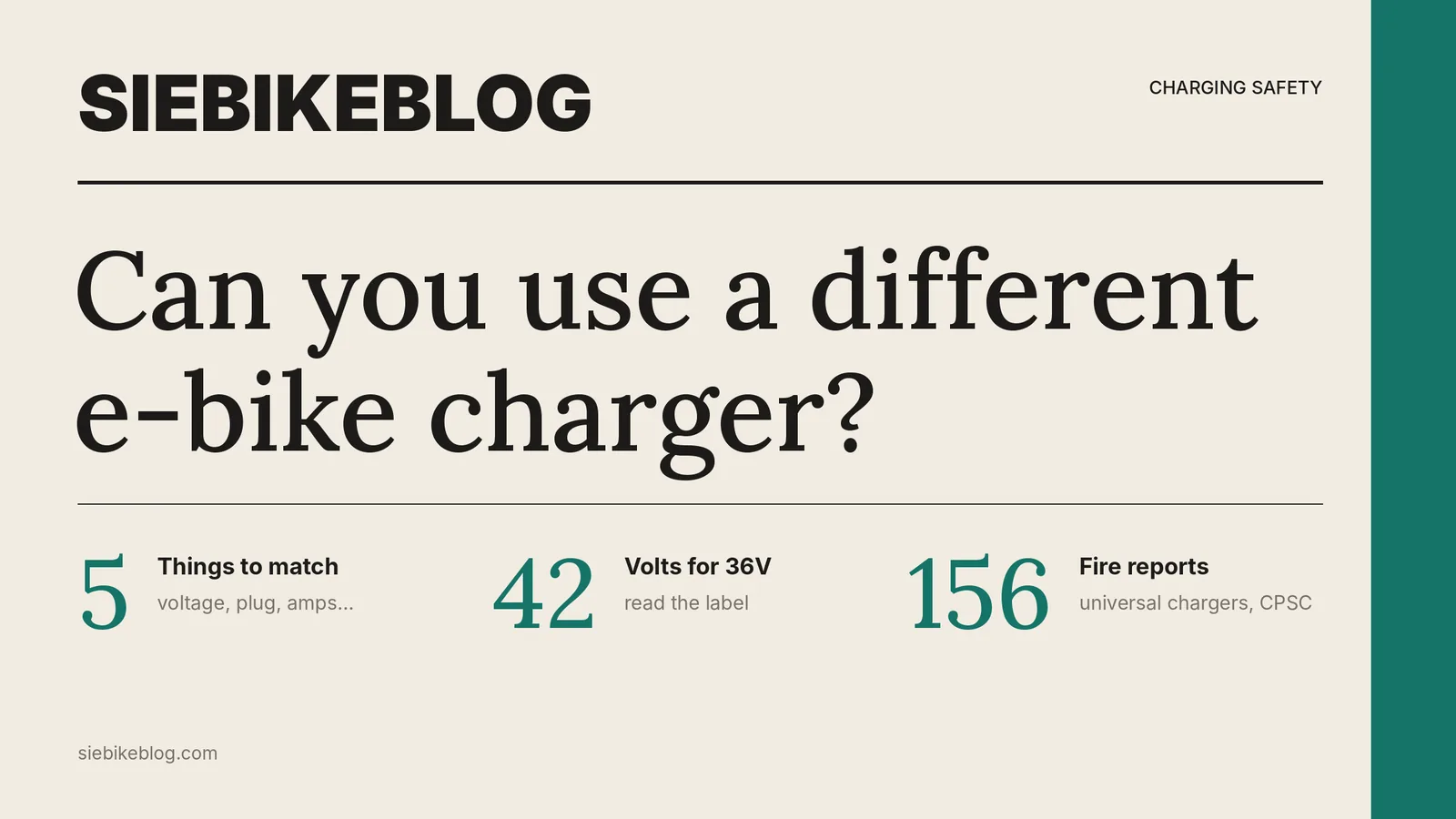
Quick Answer: Can you use a different charger for an e-bike battery? Only if it matches your battery exactly: same voltage, same battery chemistry, same plug and polarity, a safe current, and approval from your bike’s brand. U.S. safety regulators warn against “universal” chargers, because one can fit the port and still be incompatible.
Key Takeaways
- A plug that fits is not proof of a match. Voltage, chemistry, polarity and current all have to line up.
- The CPSC logged 156 fire and thermal incidents involving universal micromobility chargers between January 2023 and May 2024.
- A 36V lithium-ion battery needs a charger that stops at about 42 V; a 48V pack needs about 54.6 V.
- Branded systems often need the brand’s own charger, because the charger talks to the battery’s electronics.
- The safest replacement is the original model or one your bike’s brand lists as compatible.
Chargers get lost, left at work or break, and the box of spares in the garage always seems to have one with a plug that fits. It’s tempting to use it. But e-bike chargers aren’t interchangeable the way phone chargers have become, and the wrong one can damage the battery or start a fire.
This guide explains the five things a charger must match, how to read the label, why universal chargers are a problem, whether faster chargers are safe, and how to buy the right replacement.
Table of Contents
- What must a replacement charger match?
- How do you read an e-bike charger label?
- Are universal e-bike chargers safe?
- Can you use a faster charger?
- How do you choose a safe replacement?
- Frequently asked questions
What Must a Replacement E-Bike Charger Match?
Five things, and all five have to be right. If any one is wrong, don’t use the charger.
| Must match | What to check | What happens if it’s wrong |
|---|---|---|
| 1. Voltage | Charger output matches the battery’s system voltage (36V, 48V, 52V) | Too high can overcharge and overheat the cells; too low never fills the battery |
| 2. Chemistry | Lithium-ion (NMC) and LiFePO4 packs need different full-charge voltages | The battery is overcharged or undercharged on every cycle |
| 3. Plug and polarity | Same connector and the same positive/negative pin layout | A reversed plug can short the battery or destroy the BMS |
| 4. Current (amps) | Charger amps at or below what the battery and BMS allow | Too much current heats the cells and wears them faster |
| 5. Brand compatibility | The bike’s maker lists the charger as approved | Smart batteries may refuse to charge, or charge without proper protection |
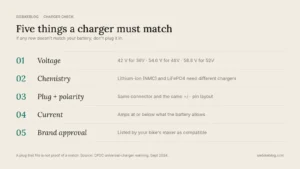
If any row doesn’t match your battery, don’t plug the charger in.
The voltage row needs a closer look. A lithium-ion charger is built to stop at a precise voltage. Battery University explains that lithium-ion “cannot absorb overcharge” and that charging current must be cut off once the battery is full. A charger built for a higher-voltage pack will keep pushing past that point.
The last row matters most on branded systems. Many big-brand e-bike batteries share data with their charger, so only the matching charger will charge them properly, even if another charger has the same voltage.
How Do You Read an E-Bike Charger Label?
Find the “Output” line on the charger, then compare it with your battery label. The output voltage on a charger is the full-charge voltage, which is higher than the battery’s nominal number.
| Battery label (nominal) | Lithium-ion charger output should read | Number of cells in series |
|---|---|---|
| 36V | about 42 V | 10 |
| 48V | about 54.6 V | 13 |
| 52V | about 58.8 V | 14 |
Values for standard lithium-ion (NMC) packs at 4.2 V per cell. LiFePO4 batteries use a lower voltage per cell and need their own chargers.
Worked example
Your battery says 36V 14Ah. You find a spare charger that says Output: 54.6V 2A.
- 54.6 V is the full-charge voltage for a 48V battery, not a 36V one.
- On your 36V pack, that charger would try to push each cell to about 5.5 V, far beyond the safe 4.2 V. The battery’s BMS might cut it off, but that’s a last line of defence, not something to rely on.
- Verdict: don’t use it, even if the plug fits perfectly.
A charger reading 42V 2A would match on voltage. You’d still need to confirm the plug polarity, that the battery is NMC lithium-ion, and that your bike’s brand approves it. If a charger has stopped working altogether, our guide on why an e-bike battery won’t charge shows how to test its output with a multimeter.
Are Universal E-Bike Chargers Safe?
Not according to U.S. safety regulators. In September 2024 the Consumer Product Safety Commission urged people not to buy or use universal chargers with e-bikes and other micromobility products. It said such chargers “may fit into your device but still be incompatible with it,” and reported 156 fire and thermal incidents involving them between January 2023 and May 2024.
The CPSC’s advice is simple:
- Use only the charger provided with your e-bike.
- Before buying a replacement, make sure it’s been tested and approved to work with your device.
- Don’t use a charger from another e-bike or scooter without confirming compatibility.
- Unplug the charger when charging is finished, and don’t charge while you sleep.
Universal chargers often have adjustable voltage switches or several plug tips. Setting the wrong voltage, choosing the wrong tip or getting the polarity backwards are all easy mistakes, and any one of them can damage the battery.
Certification helps you spot better-made products. A charger sold as part of a UL 2849-certified e-bike system has been tested together with that bike’s battery and motor. A charger that only claims to fit “most e-bikes” hasn’t been tested with yours.
Can You Use a Faster Charger on an E-Bike Battery?
Yes, if it’s an approved fast charger for your battery. A faster charger keeps the same voltage but delivers more amps, so it fills the battery sooner.
The ratio between charger amps and battery size shows how hard the charger pushes. For a 14 Ah battery:
| Charger | Charge rate | Approximate main-charge time |
|---|---|---|
| 2A | about 0.14C (gentle) | about 7 hours |
| 4A | about 0.29C (moderate) | about 3.5 hours |
| 6A | about 0.43C (fast) | about 2.3 hours |
C-rate = charger amps ÷ battery Ah. Times are Ah ÷ amps for the main charge, plus a short top-off.
A brand-approved fast charger is designed within the cells’ limits, so it’s fine for regular use, though slower charging is a little gentler on the cells over many years. An unbranded “high-amp” charger is a different matter: if it exceeds what the battery’s BMS allows, the cells heat up and age faster. Our guide to what Ah means on an e-bike battery explains how charger amps and battery size work together.
How Do You Choose a Safe Replacement Charger?
Start with your bike’s brand, not a marketplace search. Follow these steps:
- Find the original charger’s model number. It’s on the charger label, in the manual, or on the brand’s website.
- Buy that model, or one the brand lists as compatible. Bike shops can order original chargers for most brands.
- Check the label before you plug in. Voltage, chemistry, plug and amps should all match your battery.
- Look for a recognised safety mark. UL, ETL, CE or the equivalent for your country.
- Watch the first charge. Stay nearby, feel the charger and battery after 30 minutes, and unplug when it’s done.
Warning signs the charger is wrong
Stop and unplug at the wall if you notice any of these:
- The charger or battery gets hot, not just warm
- A burning or chemical smell
- The battery shows full far sooner than usual, or never fills
- The plug feels loose, sparks or needs force to insert
- The battery’s charge light flashes an error
If the battery looks swollen or damaged after using the wrong charger, stop using it altogether. And once you have the right charger, our guide to charging an e-bike battery overnight covers where and when to charge safely.
Frequently Asked Questions
Are all e-bike chargers the same? No. They differ in voltage, plug, polarity, current and, on branded systems, the way they communicate with the battery.
Can I use a 48V charger on a 36V battery? No. A 48V charger outputs about 54.6 V, far more than the 42 V a 36V lithium-ion battery should reach.
Can I use a 36V charger on a 48V battery? It won’t charge the battery properly and may confuse the BMS. Always use a charger made for your battery’s voltage.
Can I use a laptop or scooter charger with the same plug? No. Laptop and scooter chargers are built for different voltages and batteries, even when the plug looks identical.
Will a different charger void my warranty? Often, yes. Many brands exclude damage caused by non-approved chargers, so check your warranty terms.
What should I do if I’ve already used the wrong charger? Unplug it, let the battery rest somewhere safe, and check it for heat, swelling or a smell. If anything seems wrong, contact the brand or a dealer before using it again.
The Bottom Line
You can use a different charger for an e-bike battery only when it matches on voltage, chemistry, plug, current and brand approval. When in doubt, buy the original model from your bike’s brand, and skip universal chargers.

Leave a Reply