
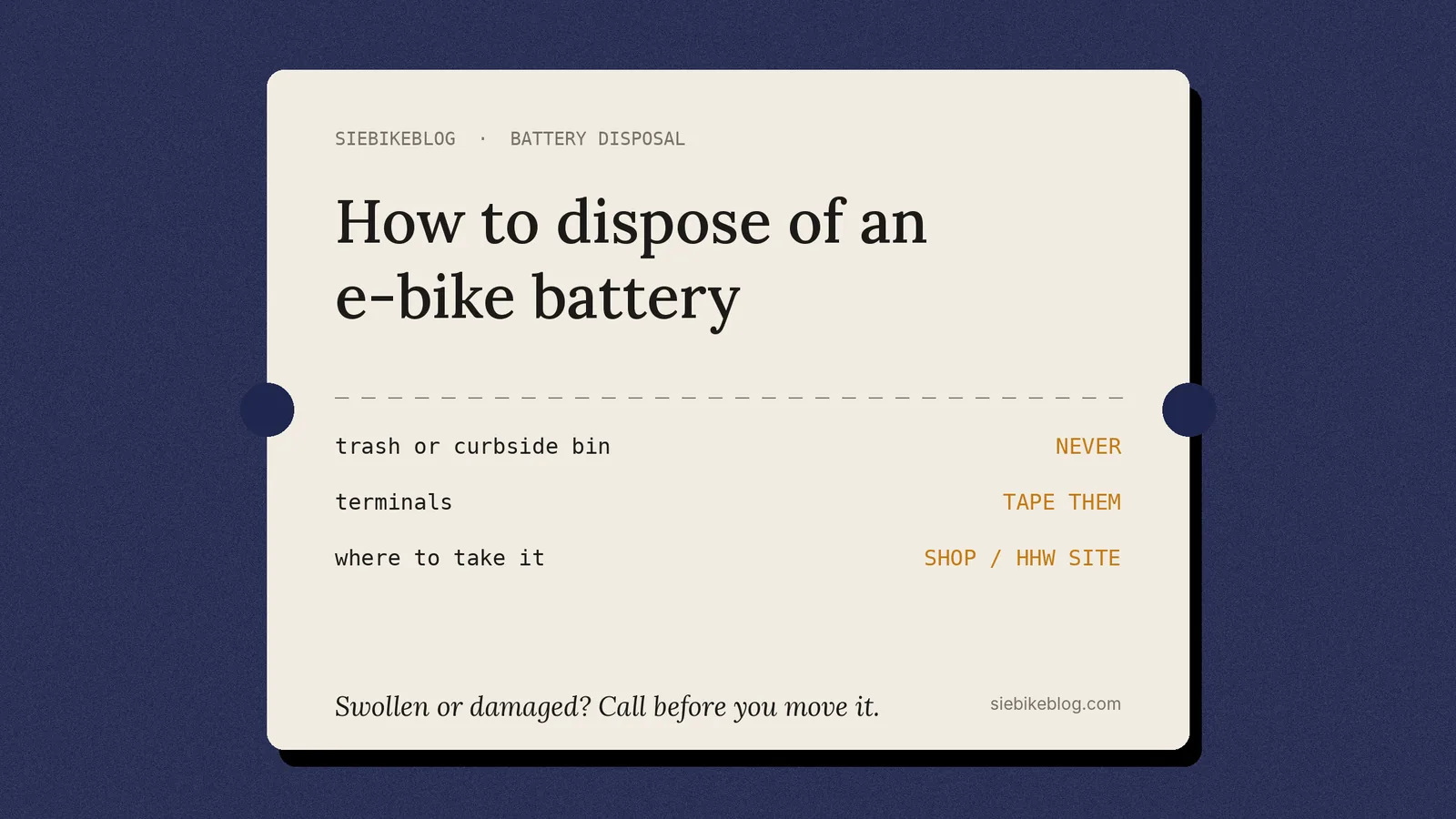
Quick Answer: To dispose of an e-bike battery, never put it in the trash or curbside recycling bin. Switch it off, tape over the terminals, put it in a plastic bag, and take it to a battery recycling drop-off: a participating bike shop, your local household hazardous waste site, or the brand’s take-back program.
Key Takeaways
- E-bike batteries are lithium-ion, and the EPA says they should not go in household garbage or recycling bins.
- Tape the terminals and bag the battery before you move it.
- In the US, an industry program run with Call2Recycle accepts batteries from participating brands at bike shops nationwide.
- A swollen, leaking or hot battery needs special handling: call the drop-off site or manufacturer first.
- Check that the battery is actually dead; a weak pack can sometimes be rebuilt.
An old e-bike battery still holds a lot of energy, even when it no longer takes you far. Thrown in a bin, it can be crushed in a garbage truck or at a sorting plant and start a fire.
This guide explains how to prepare the battery, where to take it in the US, UK and EU, what to do if it’s damaged, and how to check whether it really needs replacing.
Table of Contents
- Why can’t you throw an e-bike battery in the trash?
- How do you prepare an e-bike battery for disposal?
- Where can you recycle an e-bike battery?
- What if the battery is swollen or damaged?
- Should you recycle it, or can it be rebuilt?
- Frequently asked questions
Why Can’t You Throw an E-Bike Battery in the Trash?
Because a lithium-ion battery that gets crushed or punctured can short-circuit, overheat and catch fire, and the trash and recycling system crushes almost everything.
The U.S. Environmental Protection Agency says lithium-ion batteries should not go in household garbage or recycling bins, because they can be damaged during collection and sorting. It also notes a rise in fires at recycling and waste facilities across the country. The London Fire Brigade gives the same advice in the UK.
Three things make e-bike batteries a bigger problem than a phone battery:
- Size. A typical 36V or 48V e-bike pack holds roughly 400 to 700 Wh, many times the energy of a laptop battery.
- Leftover charge. A “dead” e-bike battery is rarely empty; it has just lost capacity. It can still hold enough energy to start a fire.
- Value. The cells contain lithium, cobalt, nickel and copper that recyclers can recover and reuse. In a landfill, those materials are lost.
In many places, putting a lithium-ion battery in the trash is also against local waste rules.
How Do You Prepare an E-Bike Battery for Disposal?
Preparation takes about ten minutes and makes the battery much safer to store and carry.
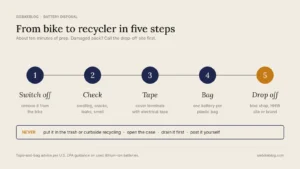
- Switch it off and remove it. Turn the battery off, unlock it, and take it off the bike. Unplug the charger.
- Don’t try to drain it. Riding or connecting it to something to empty it isn’t necessary, and a deeply discharged pack can be harder for recyclers to handle. Don’t open the case either.
- Check for damage. Look for swelling, cracks, leaks, burn marks or a chemical smell. If you see any of these, skip to the damaged battery section below.
- Tape the terminals. Cover the metal contacts, and the charging port if it’s exposed, with electrical tape. The EPA recommends non-conductive tape so nothing metal can bridge them.
- Bag it. Put the battery in its own clear plastic bag, separate from other batteries and tools.
- Store it safely until drop-off. Keep it somewhere cool and dry, on a hard surface, away from flammable things and exits. Don’t leave it in a car.
- Call ahead. Confirm the site accepts whole e-bike battery packs, not just small household batteries, before you drive there.
Keep the charger and any cables separate. They contain no lithium cells and usually go with ordinary electronic waste.
Where Can You Recycle an E-Bike Battery?
Start with the shop or brand that sold you the bike, then try your local council or county. Here are the main options by country:
| Where you live | Best first option | Backup options |
|---|---|---|
| United States | A bike shop in the industry e-bike battery recycling program | County household hazardous waste (HHW) site; Call2Recycle drop-off locator; the bike’s manufacturer |
| United Kingdom | Your council’s household waste recycling centre (call first) | The retailer that sold the bike; the Recycle Your Electricals locator |
| European Union | The shop that sells e-bike batteries, which must take old ones back | Municipal recycling centre; the battery brand’s dealer network |
| Anywhere else | The bike’s dealer or brand | Local hazardous waste or e-waste facility |
The US e-bike battery recycling program
PeopleForBikes and Call2Recycle run a nationwide take-back program called Hungry for Batteries. Participating brands pay into a shared fund, retailers get safety training and approved shipping kits, and riders drop the battery off at a participating shop.
By July 2024 the program had collected about 85,000 pounds of e-bike batteries through more than 2,100 retail drop-off locations. Two things to check first:
- Your brand must take part. The program website lists participating brands. If yours isn’t there, contact the brand directly.
- The bike must be a Class 1, 2 or 3 e-bike. Batteries from faster, out-of-class machines aren’t accepted.
Household hazardous waste sites
Most US counties and UK councils accept lithium-ion batteries at a hazardous waste or recycling centre, often for free. Some limit the size or number of batteries, or only take them on certain days, so phone or check the website first.
What it costs
Dropping off a single e-bike battery is usually free. The US industry program is paid for by the participating brands, and many public hazardous waste sites take household batteries at no charge. Some private recyclers or small towns charge a handling fee, mostly because large lithium-ion packs cost more to ship safely, so ask when you call.
What If the Battery Is Swollen or Damaged?
A damaged battery is the most dangerous kind to move, so treat it differently from a pack that has simply worn out.
Signs of damage include a bulging or split case, a battery that rocks on a flat table, leaking fluid, scorch marks, a sweet or chemical smell, or a pack that was in a crash or got very wet. Our guide on how to tell if an e-bike battery is swollen walks through a five-minute check.
If you find any of those signs:
- Stop using and charging it straight away.
- Move it outside or to a safe spot on concrete or stone, away from the house, cars and anything that burns, but only if it’s cool and not smoking.
- Don’t press, puncture or tape over the swelling.
- Call before you transport it. Ask the drop-off site or the manufacturer how they want it packed. Some shops use special containers for damaged packs and won’t accept one carried in loose.
- Keep it apart from other batteries while it waits.
If the battery is hot, hissing, smoking or on fire, don’t touch it. Leave the building, close the door behind you and call the fire service.
Should you discharge a battery before disposal?
No. Recyclers and fire services don’t ask riders to empty e-bike batteries first. Running a damaged pack down can make it heat up, and a healthy pack is safe at its current charge once the terminals are taped.
Should You Recycle It, or Can It Be Rebuilt?
Before you hand a battery in, make sure it’s really finished. Many “dead” batteries have a fixable fault, and a new pack often costs several hundred dollars.
| What you notice | Likely cause | What to do |
|---|---|---|
| Won’t charge at all, no lights | Deep-discharge sleep, blown fuse or charger fault | Test with a known-good charger; ask a shop to check it |
| Range is 30–40% shorter than new | Normal ageing | Keep riding if the range still works for you |
| Range drops suddenly, or cuts out on hills | One weak cell group | A battery rebuilder may replace the cells |
| Swollen, leaking, cracked or crash-damaged | Physical damage | Recycle it; don’t repair or reuse |
Our guide on how long an e-bike battery lasts explains normal capacity loss, and the e-bike battery life calculator estimates how much life a pack has left. If yours won’t charge, read why an e-bike battery isn’t charging first, since a sleeping battery can sometimes be woken.
Rebuilding means a specialist opens the case and fits new cells. It can save money on older or discontinued packs, but it usually voids any warranty, and the work should only be done by an experienced battery shop. Never open a battery yourself.
When you buy a replacement, ask the shop to take the old one back at the same visit. It saves a second trip.
Frequently Asked Questions
Can I put an e-bike battery in the recycling bin? No. Curbside recycling trucks and sorting plants crush batteries, which can start fires. Take it to a battery drop-off instead.
Will a bike shop take my old e-bike battery? Many will, especially shops in the US industry recycling program or the shop that sold you the bike. Call first, since some only accept brands they sell.
Is it free to recycle an e-bike battery? Usually, yes, at participating shops and most public hazardous waste sites. A few private recyclers charge a handling fee.
How should I store an old battery until I can drop it off? Switched off, terminals taped, in a plastic bag, somewhere cool and dry on a hard surface, away from flammable items and exits.
Can I mail an e-bike battery to a recycler? Only through a program that sends you an approved shipping kit. Large lithium-ion batteries are regulated as dangerous goods, so don’t post one yourself.
What happens to a recycled e-bike battery? The pack is dismantled, and the cells are processed to recover metals such as lithium, cobalt, nickel and copper for new batteries.
The Bottom Line
To dispose of an e-bike battery safely, keep it out of the trash, tape the terminals, bag it and take it to a bike shop, hazardous waste site or brand take-back program. If it’s swollen or damaged, call ahead before moving it.

Leave a Reply