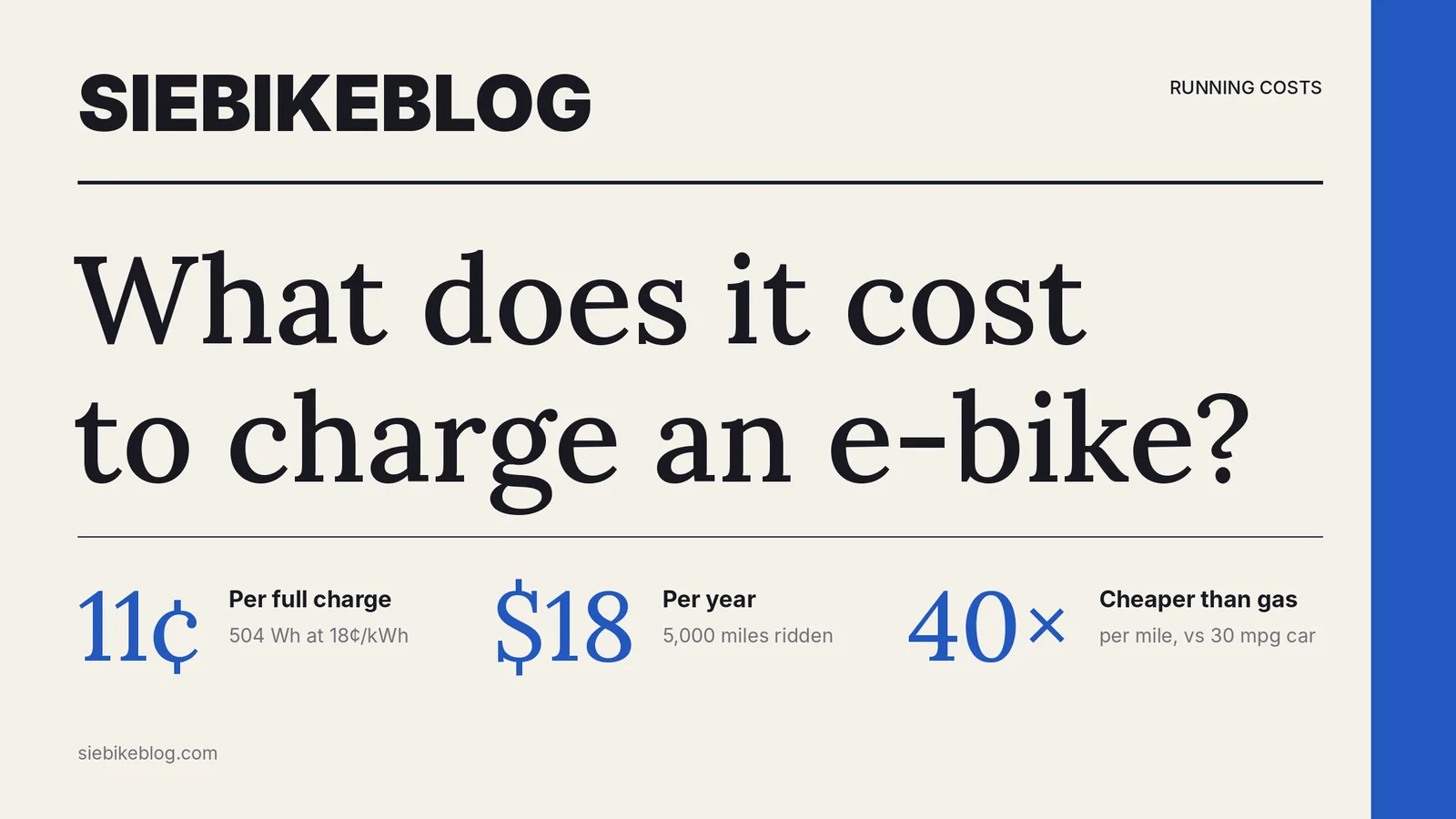
Quick Answer: It costs about 8 to 20 cents to fully charge an e-bike at the average US home electricity price of roughly 18 cents per kWh. A typical 500 Wh battery costs about 11 cents per charge, which works out to around a third of a cent per mile, or $10–$20 a year for most riders.
Key Takeaways
- Cost per charge = battery Wh ÷ 1,000 ÷ charger efficiency × your price per kWh.
- Allow about 15% extra for charger losses; most guides leave this out.
- A 504 Wh battery costs about 11 cents to fill at 18 cents/kWh, and 28 cents in Hawaii.
- Riding 5,000 miles a year costs about $18 in electricity, against roughly $700 in fuel for a 30 mpg car at current gas prices.
- Battery wear costs more per mile than electricity: around 2–3 cents a mile.
E-bikes are among the cheapest ways to travel, and charging is the smallest part of the bill. But “a few cents” is easy to say; this guide shows the real numbers with 2026 electricity and gas prices, including the charger losses most calculators skip.
You’ll find the formula, a cost table for common battery sizes, cost per mile and per year, and what really drives the long-term cost of running an e-bike.
Table of Contents
- How do you calculate the cost to charge an e-bike?
- How much does one charge cost for different batteries?
- How much does an e-bike cost per mile and per year?
- What makes charging cost more or less?
- Frequently asked questions
How Do You Calculate the Cost to Charge an E-Bike?
You need three numbers: your battery’s size in watt-hours (Wh), your electricity price per kilowatt-hour (kWh), and the charger’s efficiency.
Cost per full charge = (battery Wh ÷ 1,000) ÷ 0.85 × price per kWh
The 0.85 accounts for energy lost as heat in the charger and battery, roughly 15% for a typical e-bike charger. Most online calculators skip it, so they come out a little low.
Step 1: Find your battery’s watt-hours
Look for “Wh” on the battery label. If it only shows volts and amp-hours, multiply them: a 36V 14Ah battery holds 36 × 14 = 504 Wh. Our guide on what Ah means on an e-bike battery explains the label in more detail.
Step 2: Find your price per kWh
Check your latest electricity bill for the price per kWh, including delivery charges. The US average for homes was about 18.2 cents per kWh in August 2026, according to EIA data compiled by ElectricityPlans, from about 12.7 cents in Nevada to 47.2 cents in Hawaii.
Step 3: Do the math
For a 504 Wh battery at 18.2 cents per kWh:
- 504 ÷ 1,000 = 0.504 kWh stored in the battery
- 0.504 ÷ 0.85 = 0.59 kWh drawn from the wall
- 0.59 × $0.182 = about $0.11 per full charge
That’s for charging from empty. Most riders top up from 30–50%, so a typical charge costs even less. To skip the arithmetic, use our e-bike battery charging calculator.
How Much Does One Charge Cost for Different Batteries?
The table shows the cost of a full charge from empty, including 15% charger losses, at four electricity prices: a cheap state, the US average, an expensive state, and Hawaii.
| Battery | Energy from the wall | At 12¢/kWh | At 18¢/kWh (US average) | At 30¢/kWh | At 47¢/kWh (Hawaii) |
|---|---|---|---|---|---|
| 36V 10Ah (360 Wh) | 0.42 kWh | 5¢ | 8¢ | 13¢ | 20¢ |
| 36V 14Ah (504 Wh) | 0.59 kWh | 7¢ | 11¢ | 18¢ | 28¢ |
| 48V 14Ah (672 Wh) | 0.79 kWh | 9¢ | 14¢ | 24¢ | 37¢ |
| 52V 17.5Ah (910 Wh) | 1.07 kWh | 13¢ | 19¢ | 32¢ | 50¢ |
Even the biggest common battery costs less than a dollar to fill anywhere in the US. Outside the US, use the same formula with your local price; in most of Europe, a full charge still costs well under a euro.
Charging overnight doesn’t change the cost per charge, only when you pay it. If you charge overnight, read our guide on charging an e-bike battery overnight for the safe way to do it.
How Much Does an E-Bike Cost per Mile and per Year?
Assume a 504 Wh battery gives about 30 miles of mixed riding. At 18.2 cents per kWh, that’s about 0.36 cents per mile, or roughly a penny every three miles. Your range may differ; the e-bike range calculator estimates it from your battery, weight and terrain.
| Miles ridden per year | Electricity cost per year | Fuel for a 30 mpg car at $4.27/gal |
|---|---|---|
| 1,000 (weekend rides) | about $4 | about $142 |
| 2,600 (10-mile commute, 5 days a week) | about $9 | about $370 |
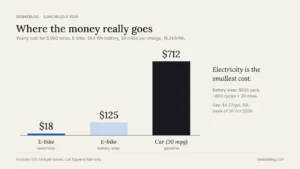
| 5,000 (daily rider) | about $18 | about $712 |
The car figures use the US average of $4.27 a gallon for regular gasoline in the week of October 26, 2026, from the U.S. Energy Information Administration. They cover fuel only; insurance, parking and servicing widen the gap further. Compare your own commute with the e-bike vs car commute savings calculator.
The bigger cost: battery wear
Electricity is the cheapest part of running an e-bike. Every charge also uses up a little of the battery’s life.
A $600 replacement battery that lasts about 800 full cycles at 30 miles each covers roughly 24,000 miles. That’s about 2.5 cents per mile, around seven times the electricity cost. Our guide on how long an e-bike battery lasts explains how to stretch those cycles further.
What Makes Charging Cost More or Less?
The difference between a cheap and an expensive charge is a few cents, but a few habits matter more than others.
- Your electricity rate. It’s the biggest factor. Prices vary almost fourfold between US states.
- Time-of-use plans. If your utility charges less at night, charging then can cut the cost by a third or more. Stay nearby while it charges and unplug when it’s done.
- Charger quality. A good charger wastes around 10–15% as heat; a cheap or failing one wastes more and runs hot.
- Leaving it plugged in. A charger left in the wall after the battery is full draws a small standby current. It costs pennies a year, but unplugging is safer anyway.
- Riding style. High assist levels, hills, headwinds and soft tires all use more energy per mile, so you charge more often.
- Cold weather. Batteries deliver less range in the cold, so winter riding costs a little more per mile.
Is public charging free?
Some cafes, offices and city charging points let you plug in for free, which saves a few cents. Ask before you plug in, use your own charger, and never leave a charging battery unattended in a public place.
Does pedaling reduce the cost?
Only in the sense that more leg power means less battery use. Pedaling doesn’t recharge most e-bikes, as we explain in does pedaling charge an e-bike battery.
Frequently Asked Questions
How much does it cost to charge an e-bike per month? For most riders, under $2. A 10-mile weekday commute costs about 80 cents a month at the US average electricity price.
Does charging an e-bike raise your electricity bill much? No. Even daily riding adds about $1.50 a month, roughly what a fridge uses in a week.
Is it cheaper to charge an e-bike or an electric car? An e-bike, by a wide margin. It uses roughly a tenth of the energy per mile of an electric car.
How many kWh does an e-bike use? About 0.4–1.1 kWh from the wall per full charge, depending on battery size. That’s around 0.02 kWh per mile.
Does a fast charger cost more to use? Not noticeably. It puts in the same energy faster. It may waste slightly more as heat and wear the battery a little sooner.
How much does it cost to charge an e-bike in the UK? At a typical UK price of 25–30p per kWh, a 504 Wh battery costs roughly 15–18p to fill. Check your tariff for the exact rate.
The Bottom Line
Charging an e-bike costs about 8 to 20 cents per full charge at average US prices, or $10–$20 a year for most riders. Electricity is the cheapest part of e-bike ownership; looking after the battery saves far more.

Leave a Reply