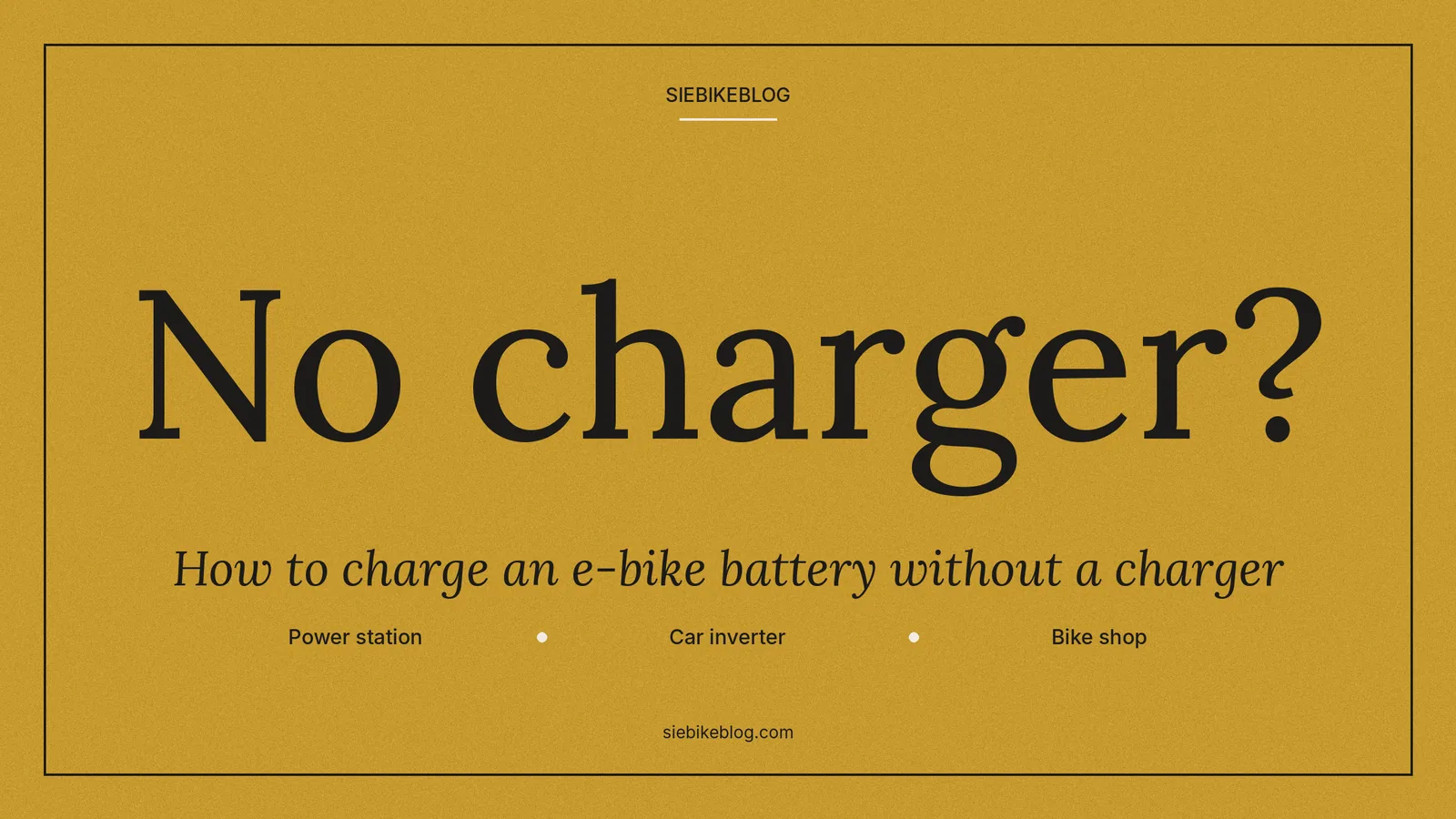
Quick Answer: You can’t safely charge an e-bike battery without a charger, but you can charge it without a wall socket. Run your original charger from a portable power station or a properly rated car inverter, borrow an identical charger, or ask a bike shop. Never connect a battery straight to a power supply, car battery or solar panel.
Key Takeaways
- Every safe method still uses a charger made for your battery; only the power source changes.
- A portable power station needs roughly 1.25 Wh for every 1 Wh of battery, to cover charger and inverter losses.
- A car’s 12V socket usually supplies 120–180 W, enough for a small 2A charger but not a fast one.
- The CPSC logged 156 fire or overheating reports involving “universal” e-bike chargers in early 2024.
- Pedaling won’t recharge most e-bikes, so with a flat battery you ride home on leg power.
Most people search this after leaving the charger at home, losing it, or finding it broken. The good news: the problem is usually the power source, not the charger, and that has several safe fixes.
This guide covers the options that work, the shortcuts that can start a fire, how big a power station you need, and how to get home on a flat battery.
Table of Contents
- Can you charge an e-bike battery without its charger?
- What are the safe ways to charge away from home?
- Which charging methods should you avoid?
- How do you get home with a flat battery?
- Frequently asked questions
Can You Charge an E-Bike Battery Without Its Charger?
Not safely. The charger does more than push power in: it delivers the exact voltage your battery needs, limits the current, and switches off when the cells are full. A 36V battery, for example, needs a charger that stops at 42V; a 48V battery needs 54.6V. Anything that doesn’t do that job can overcharge the cells.
That’s why the U.S. Consumer Product Safety Commission tells riders to charge only with the supplied charger, and to buy any replacement from the original manufacturer. In a September 2024 statement it reported 156 fire or overheating incidents involving “universal” micromobility chargers between January and mid-May 2024.
What you can change is where the charger gets its power. Here’s how the common options compare:
| Option | Safe? | Notes |
|---|---|---|
| Original charger on a portable power station | Yes | Check the station’s continuous AC output and capacity |
| Original charger on a car inverter | Yes, if rated | Pure sine wave, enough watts, engine running |
| Identical charger borrowed from a friend | Yes | Same brand, model, voltage and plug |
| Replacement charger from the manufacturer | Yes | The best long-term fix |
| Bike shop or dealer | Yes | Many will top up a battery or sell a charger |
| “Universal” adjustable charger | Risky | Wrong settings can overcharge the battery |
| Lab power supply, car battery or solar panel wired straight to the battery | No | No charge control; real fire risk |
| USB power bank with an adapter cable | No | Not enough voltage or power; unsafe adapters |
What Are the Safe Ways to Charge Away From Home?
All five options below keep a proper charger in the loop.
1. Use a portable power station
A portable power station is a large rechargeable battery with normal AC sockets. Plug your e-bike charger into it exactly as you would at home.
Two numbers matter:
- Continuous AC output (watts). It must be higher than your charger’s input. A typical 2A charger draws around 100 W; a 4A fast charger can draw 250 W or more. The charger label lists its input.
- Capacity (watt-hours). Some energy is lost in the station’s inverter and the charger, so plan on about 1.25 Wh of station capacity for every 1 Wh of e-bike battery.
| E-bike battery | Station capacity for one full charge | Roughly half a charge |
|---|---|---|
| 36V 10Ah (360 Wh) | about 450 Wh | about 225 Wh |
| 36V 14Ah (504 Wh) | about 630 Wh | about 315 Wh |
| 48V 14Ah (672 Wh) | about 840 Wh | about 420 Wh |
| 52V 17.5Ah (910 Wh) | about 1,140 Wh | about 570 Wh |
If you’re not sure of your battery’s watt-hours, multiply volts by amp-hours. Our 36V vs 48V e-bike battery guide explains the numbers on the label.

2. Use a car inverter
An inverter turns your car’s 12V supply into household AC, so your charger can run from it.
- Choose pure sine wave. Many charger makers advise against cheaper modified sine wave inverters, which can make chargers run hot.
- Mind the socket limit. A cigarette-lighter socket is usually fused at 10–15 amps, about 120–180 W. That suits a small 2A charger. A fast charger needs an inverter wired directly to the car battery.
- Keep the engine running for long charges, so you don’t flatten the car battery.
- Don’t leave it unattended in a closed car, and avoid hot or freezing cars.
3. Borrow an identical charger
A charger from a friend with the same bike, or the same battery model, is fine. “Same plug” isn’t enough: the output voltage, chemistry, current and pin layout all have to match. Our guide on using a different charger for an e-bike battery lists what to check.
4. Ask a bike shop
A dealer for your brand can often top up your battery while you wait, or sell you a genuine replacement charger the same day. It’s also the safest place to get a lost charger replaced.
5. Buy a replacement charger
If the charger is lost or broken, order one from the bike or battery maker, or an authorized dealer. Avoid cheap no-name chargers sold online as “compatible with most e-bikes”. The e-bike battery charging calculator shows how long a new charger’s amp rating will take to fill your battery.
Which Charging Methods Should You Avoid?
Several “hacks” circulate online. Each skips the charge control that keeps lithium-ion cells safe. The U.S. Fire Administration advises using only the charger made for the device, and these methods are the reason why.
Bench or lab power supply
In theory, an adjustable supply set to the right voltage and current can charge a battery. In practice, one wrong dial setting, a loose clip or reversed polarity can overcharge or short the pack, and it won’t switch off by itself when the battery is full. It’s a technician’s tool, not a roadside fix.
Car battery wired directly
A car battery is 12V. An e-bike battery is 36V, 48V or 52V. Clipping one to the other won’t charge it, and adding a cheap DC “booster” removes every safety feature a real charger has.
Solar panel wired directly
A panel’s voltage swings with sunlight and has no full-charge cut-off. Solar is fine as a way to refill a portable power station, which then runs your normal charger.
USB power bank
Adapters that claim to charge an e-bike battery from a phone power bank face two limits: a typical power bank holds a fraction of an e-bike battery’s energy, and the adapters often lack proper protection.
Opening the pack
Charging cells individually or bypassing the battery management system (BMS) is how battery fires start. Never open the case.
Warning signs to stop
Whatever method you use, unplug and move away from the battery if it gets hot to the touch, smells sweet or chemical, swells, hisses or smokes.
How Do You Get Home With a Flat Battery?
If there’s no charger or power station nearby, ride the bike as a normal bicycle. The motor simply stops helping; the pedals and gears still work.
On most e-bikes, pedaling won’t put meaningful charge back into the battery, as our guide on whether pedaling charges an e-bike battery explains. A few tips make the ride easier:
- Switch the system off once the battery is empty, so the display doesn’t keep drawing power.
- Shift to an easier gear before you stop and before hills; heavy e-bikes are hard to start in a high gear.
- Use what’s left wisely. If the battery still shows a bar, save it for the steepest climb on eco mode.
- Check your tire pressure. Soft tires make an unassisted ride much harder.
- Take public transport if the trip is long; many trains and some buses carry bikes.
To avoid the situation next time, plan rides with the e-bike range calculator and keep a spare charger at work if you commute.
Frequently Asked Questions
Can I charge my e-bike battery with a laptop or phone charger? No. Phone and laptop chargers are built for different voltages and have no charge control for an e-bike pack, which needs 42V or more and its own cut-off.
Can I charge an e-bike battery from a car’s USB port? No. A car USB port supplies only a few watts. Use a pure sine wave inverter running your normal charger instead.
How long does it take to charge from a portable power station? About the same as from the wall, because your charger sets the speed. A 2A charger fills a 500 Wh battery in roughly 6–7 hours.
Is a universal e-bike charger safe? It’s risky. Adjustable chargers can be set to the wrong voltage, and the CPSC has warned about fires linked to them. Buy from your battery’s manufacturer.
Can I charge the battery while riding? Not on most e-bikes. Only a few hub-motor models have regenerative braking, and it adds very little range.
What should I do if I’ve lost my charger? Note the battery’s voltage and connector, then order a replacement from the brand or a dealer. Ride unassisted until it arrives.
The Bottom Line
You can’t safely charge an e-bike battery without a charger, but you can charge it without a wall socket. Keep your original charger in the loop and power it from a portable power station, a rated car inverter or a bike shop’s outlet.

Leave a Reply