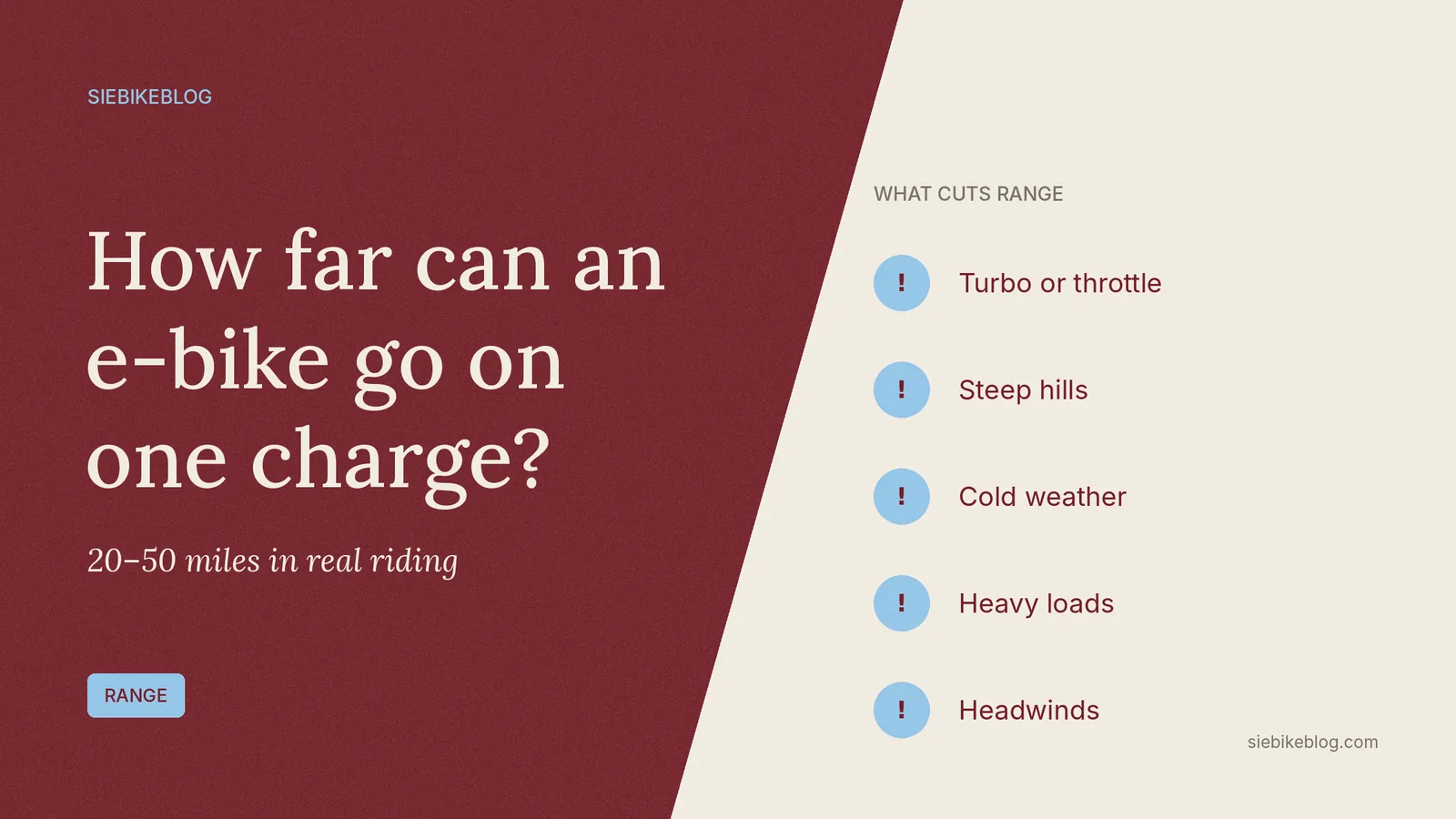
Quick Answer: Most e-bikes go 20 to 50 miles on one charge in real riding, and up to about 90 miles in the lowest assist mode on flat roads. A typical 500 Wh battery gives around 25 miles of mixed riding. Divide your battery’s watt-hours by 20 for a quick everyday estimate.
Key Takeaways
- Range ≈ battery Wh ÷ Wh used per mile. Most riders use 12–30 Wh per mile.
- A 504 Wh battery gives about 42 miles in eco on the flat, 25 miles of mixed riding, and 17 miles in turbo or on hills.
- Assist level, hills, rider weight, speed and cold weather change range the most.
- Brand range figures are best-case numbers; expect 50–70% of the maximum in everyday use.
- A battery loses range as it ages, roughly 20% by the time it’s due for replacement.
Range is the first thing most buyers ask about, and the hardest to get a straight answer on. Brands quote 80 or 100 miles, owners report 20, and both can be right.
This guide gives real-world range by battery size, shows how much each riding habit costs in miles, and explains how to work out your own bike’s range in one ride.
Table of Contents
- How far does an e-bike go by battery size?
- How much does assist level change range?
- What reduces e-bike range the most?
- Why is real range lower than the advertised range?
- Frequently asked questions
How Far Does an E-Bike Go by Battery Size?
The simplest way to estimate range is to divide the battery’s energy by how much energy you use per mile:
Range in miles ≈ battery Wh ÷ Wh per mile
If your battery only lists volts and amp-hours, multiply them (36V × 14Ah = 504 Wh). Our guide on 36V vs 48V e-bike batteries explains how voltage and amp-hours add up.
How many Wh per mile? A community testing project, the E-Bike 1000 MPG Project, measured 30 e-bikes over 3,457 miles. Pedal-assist commuters averaged about 11 Wh per mile from the wall, cargo bikes about 17, and throttle-only bikes about 33. Heavier riders, hills and higher assist push the number up.
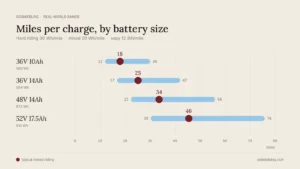
Using three typical riding styles:
| Battery | Easy riding (12 Wh/mile) | Mixed riding (20 Wh/mile) | Hard riding (30 Wh/mile) |
|---|---|---|---|
| 36V 10Ah (360 Wh) | 30 miles | 18 miles | 12 miles |
| 36V 14Ah (504 Wh) | 42 miles | 25 miles | 17 miles |
| 48V 14Ah (672 Wh) | 56 miles | 34 miles | 22 miles |
| 52V 17.5Ah (910 Wh) | 76 miles | 46 miles | 30 miles |
- Easy riding: eco mode, flat roads, light rider, steady pedaling, mild weather.
- Mixed riding: a mix of assist levels, some hills and stops, a typical commute.
- Hard riding: turbo or throttle, steep hills, heavy loads, strong wind or cold.
For your exact bike, weight and route, try our e-bike range calculator.
How Much Does Assist Level Change Range?
More than anything else you control. Moving from the lowest to the highest assist mode can cut range by more than half.
Gazelle’s range guide lists maximum ranges for a Bosch Active Line motor in good conditions. Converted to miles:
| Bosch battery | Eco | Tour (Power) | Sport | Turbo |
|---|---|---|---|---|
| 300 Wh | 56 miles | 31 miles | 25 miles | 22 miles |
| 400 Wh | 75 miles | 43 miles | 34 miles | 28 miles |
| 500 Wh | 93 miles | 56 miles | 43 miles | 37 miles |
Turbo gives about 40% of eco’s range on the same battery. These are best-case figures on a light, efficient motor; a heavier hub-drive bike or a hilly route will see much less.
How to use assist levels to go further
- Start in a low mode and save the higher ones for hills and headwinds.
- Pedal at a steady cadence of around 70–90 rpm; grinding a high gear makes the motor work harder.
- Shift down before stops so the motor doesn’t strain to get you moving.
- Use the throttle sparingly. A throttle-only ride can use two to three times the energy of pedal-assist riding.
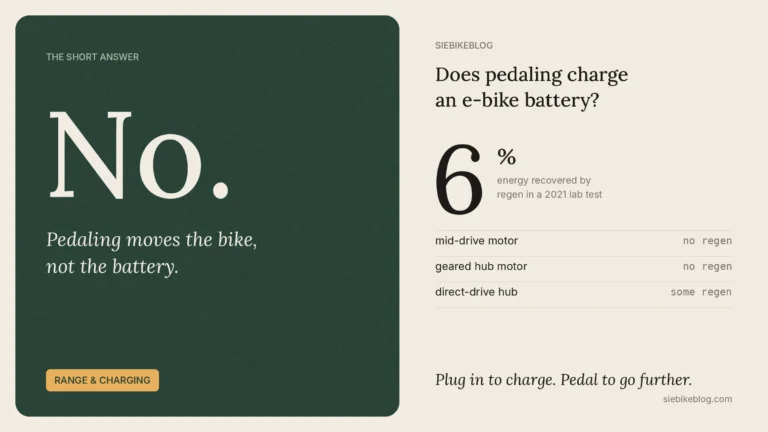
Pedaling helps range only by doing more of the work yourself. It doesn’t put charge back into most batteries, as our guide on whether pedaling charges an e-bike battery explains.
What Reduces E-Bike Range the Most?
After assist level, these are the factors that decide how far you get. The effects below are typical ranges, not exact figures; every bike and route is different.
| Factor | Typical effect on range | What you can do |
|---|---|---|
| Hills | Can halve range on steep, hilly routes | Use low gears; save high assist for climbs |
| Rider and cargo weight | Heavier loads use noticeably more energy, mostly on climbs and starts | Carry only what you need |
| Speed | Air drag rises sharply above about 15 mph | Ease off a few mph on long rides |
| Headwind | A strong headwind can cost as much as a hill | Plan routes with shelter; drop a gear |
| Cold weather | Range often falls 20–30% near freezing | Store the battery indoors and fit it just before you ride |
| Soft or knobby tires | Higher rolling resistance | Keep tires at the pressure on the sidewall |
| Stop-and-go traffic | Each restart uses extra energy | Shift down before stopping |
| Battery age | Older batteries hold less charge | Look after the battery to slow aging |
Cold weather
A cold lithium-ion battery can’t deliver its full capacity, so winter range drops even though the battery isn’t damaged. The range comes back when the weather warms up. Keep the battery indoors between rides; our guide on whether you can leave the battery on an e-bike explains when to take it off.
Battery age
Every battery slowly loses capacity with charge cycles and time. Most are considered worn out at about 80% of their original capacity, which means about a fifth less range. Our guide on how long an e-bike battery lasts covers how to slow that down.
Why Is Real Range Lower Than the Advertised Range?
Brand range figures usually describe the best possible ride: lowest assist, flat ground, a light rider, mild weather and a new battery. Some brands quote a range like “up to 80 miles” that only applies in eco mode with steady pedaling.
As a rule of thumb, expect about 50–70% of the advertised maximum in everyday riding, and less in winter or on hilly routes. When you compare bikes, compare battery watt-hours rather than range claims; Wh can’t be inflated.
How to measure your own range in one ride
- Charge the battery to 100% and note the odometer.
- Ride your normal route in your usual assist mode until the battery reaches about 20%.
- Note the miles you covered and the percentage used.
- Divide: miles ÷ percentage used × 100 = your full-charge range.
For example, 18 miles using 80% of the battery gives 18 ÷ 80 × 100 = 22.5 miles of range. You can also find your Wh per mile: battery Wh × 0.8 ÷ 18 miles.
Don’t routinely ride the battery to zero; stopping around 10–20% is easier on the cells.
How to get more range
Ride in a lower assist mode, keep tires firm, carry less, shift early, and store the battery at room temperature. Bigger gains come from a larger battery or a second battery for long tours. If you charge midway through a long ride, our guide on how much it costs to charge an e-bike shows it’s only a few cents each time.
Frequently Asked Questions
How many miles can a 500 Wh e-bike battery go? About 17 to 42 miles in real riding, and up to around 90 miles in eco mode in ideal conditions. Around 25 miles is typical for mixed riding.
Can an e-bike go 100 miles on one charge? Only with a large battery (around 1,000 Wh or more), low assist and easy terrain, or with a second battery.
Do throttle e-bikes have less range? Yes. Riding on the throttle alone can use two to three times as much energy per mile as pedal-assist riding.
Does a 48V battery go further than a 36V battery? Only if it holds more watt-hours. Range depends on Wh, not voltage alone.
Why does my range drop in winter? Cold cells deliver less of their stored energy. Keep the battery indoors and the range returns in warmer weather.
How do I know when my battery’s range is too low? If it no longer covers your usual ride, or gives about 20% less than when new, it may be time to test or replace it.
The Bottom Line
Most e-bikes go 20 to 50 miles on one charge, with a typical 500 Wh battery giving about 25 miles of mixed riding. Divide your battery’s watt-hours by 20 for a quick estimate, then measure your own range on one ride.

Leave a Reply