Quick Answer: Why is my e-bike battery not charging? Most often it’s something simple: a loose plug, a dead wall socket, a battery switched off, or a pack that’s too cold or hot to charge. If those check out, the charger may be faulty, or the battery’s protection system has shut it down after sitting empty too long.
Key Takeaways
- Start with the easy checks: wall socket, both plugs, the battery’s on/off switch and the charger light.
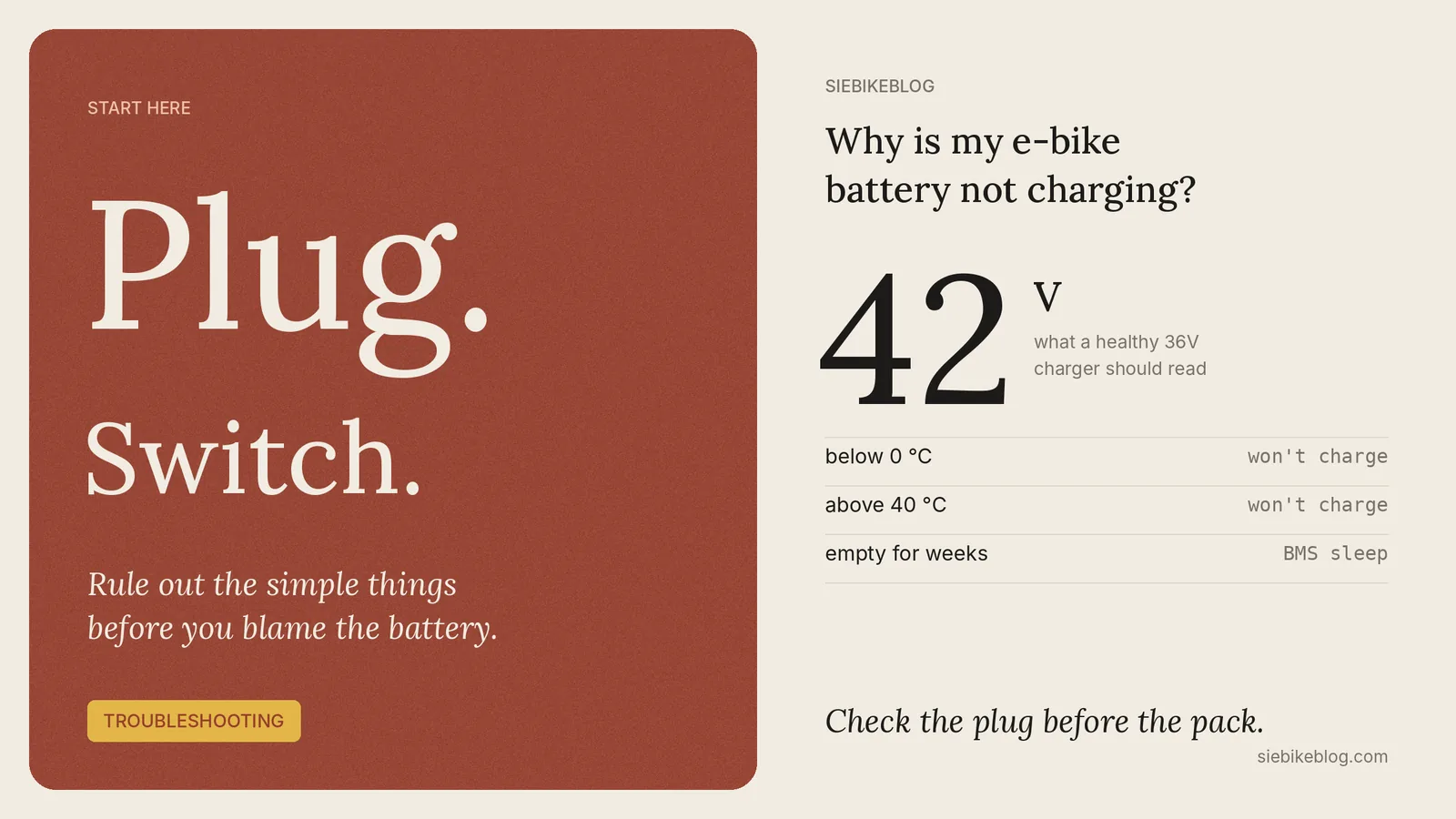
- Lithium-ion batteries shouldn’t be charged below 0°C (32°F) or above 40°C (105°F), so many packs refuse to charge outside that range.
- A battery left empty for weeks can drop into a protective “sleep” that a normal charger can’t wake.
- A charger for a 36V battery should read about 42V at its plug; much lower usually means the charger has failed.
- Swelling, heat, a smell or water damage mean stop: don’t keep trying to charge it.
You plug in your e-bike, wait, and nothing happens. The charger light stays green, or doesn’t light at all, and the battery level hasn’t moved. It’s frustrating, but in many cases the fix takes less than five minutes.
This guide walks through the checks in order, from the quickest to the most technical, explains what your charger’s light is telling you, and shows when a battery has a real fault that needs a dealer.
Table of Contents
- What should you check first?
- What do the charger lights mean?
- Can temperature or a long rest stop charging?
- Which battery faults stop charging?
- Quick troubleshooting table
- When should you stop and get help?
- Frequently asked questions
What Should You Check First When an E-Bike Battery Won’t Charge?
Check the power path from the wall to the battery, one link at a time. These five steps often solve the problem and need no tools.
- Test the wall socket. Plug in a lamp or phone charger. If nothing works, try another socket or check the breaker. Skip extension leads and power strips for this test.
- Reseat both plugs. Unplug the charger from the wall and the battery, wait 30 seconds, then push each plug in firmly. Many charge ports need a firm push or a quarter turn to seat fully.
- Look inside the charge port. Dirt, bent pins, green corrosion or moisture can block the connection. Let a wet port dry fully; clean dry dirt gently with a soft brush.
- Switch the battery on. Many packs have their own power button or key switch. On some bikes the battery must be switched on, or the bike’s display turned on, before it will accept a charge.
- Watch the charger light. Note what it does when you plug it into the wall alone, and again when you connect the battery. That pattern tells you where to look next.
If the bike has a removable battery, try charging it off the bike as well as on it. A battery that charges on its own but not on the bike points to the bike’s charge port or wiring rather than the battery.
What Do the Charger Lights Mean?
On many e-bike chargers, red or orange means charging and green means full or standby. Colors and blink patterns vary by brand, so check your manual, but the pattern below holds for a lot of common chargers.
| What you see | What it usually means | What to do |
|---|---|---|
| No light at all, plugged into the wall | Charger isn’t getting power, or it has failed | Try another socket; if still dark, the charger is likely faulty |
| Green, and it stays green when you connect the battery | Charger is working but the battery isn’t accepting current | Check the battery switch, port and temperature; then suspect the battery or BMS |
| Red, then green after only a few minutes | Battery is already full, or the BMS stopped charging early | Check the battery’s charge display; if it’s still low, see the BMS section |
| Flashing light | Error or fault code | Look up the blink pattern in your charger manual |
| Red for many hours and never turns green | Very large or worn battery, or a weak charger | Compare charge time with your battery size; a faulty charger may never finish |
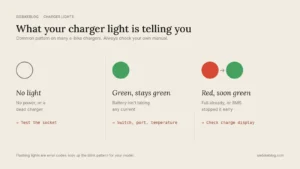
Three common charger light patterns and what to check for each.
Test the charger output
If you own a multimeter, you can check the charger in two minutes. Set the meter to DC volts, plug the charger into the wall with no battery connected, and measure across its output pins. Your user manual or the charger label shows which pins are positive and negative.
A healthy charger usually reads close to its rated output, which is about 4.2 V per cell in the pack:
- 36V system: about 42 V
- 48V system: about 54.6 V
- 52V system: about 58.8 V
A reading far below these figures means the charger has likely failed. A reading of zero needs one more check: some smart chargers only switch their output on when they detect a battery, so a zero there isn’t proof of a fault. Replace it with the original model or one approved by your bike’s brand, matched to your battery’s voltage and connector. Our guide to what Ah means on an e-bike battery explains how charger amps and battery size affect charging time.
If you’re unsure about probing the pins, skip this step and take the charger to a bike shop. A shorted charger plug can spark.
Can Temperature or a Long Rest Stop an E-Bike Battery Charging?
Yes, both are common causes, and both are protective features rather than faults.
Too cold or too hot
The U.S. Fire Administration advises against charging lithium-ion batteries below 0°C (32°F) or above 40°C (105°F). Many e-bike batteries enforce this themselves: the battery management system (BMS) blocks charging until the cells are back in range.
- After a winter ride or a night in a cold garage: bring the battery indoors and let it warm to room temperature for an hour or two before charging.
- After a hot summer ride or time in a hot car: let it cool in the shade for 30–60 minutes first.
Left empty for too long
A battery stored empty keeps losing a little charge on its own. If the cell voltage falls far enough, the protection circuit shuts the pack down to prevent damage. Battery University’s guide to sleeping lithium-ion batteries says protection circuits typically cut off between 2.2 V and 2.9 V per cell, and that a normal charger often can’t wake a pack in that state.
What to do:
- Leave the battery connected to its own charger for 30–60 minutes; some BMS designs recover slowly.
- If the level still doesn’t rise, stop. Don’t use a different or higher-voltage charger to “jump” it.
- Take it to your dealer or a battery specialist. Battery University warns that cells left below 1.5 V for more than a week may have internal damage that makes recharging unsafe.
The best prevention is storage at a partial charge, covered in our guide on how long an e-bike battery lasts.
Which Battery Faults Stop an E-Bike Battery From Charging?
If the socket, charger and temperature are all fine, the problem is inside the battery. These are the usual suspects, roughly from most to least fixable.
BMS lockout after a fault
The BMS can shut the pack down after a short circuit, a voltage spike or an internal error. Some packs reset after being disconnected from the bike and charger for a few minutes; others need a dealer’s diagnostic tool. Your dealer can also read error codes and the pack’s cycle count.
A blown fuse or broken internal connection
Many packs have an internal fuse or a fragile wire between the cell block and the charge port. A drop or heavy vibration can break it. The battery may still power the bike but refuse to charge, or the other way around. This repair means opening the case, which is a job for a battery specialist.
Worn-out or unbalanced cells
An old pack may charge, but only for minutes before the charger shows green, because one weak cell group reaches full voltage early. The display may jump from full to low quickly on the next ride. This is the normal end of a battery’s life rather than a sudden fault; the signs of a worn battery and the replacement options in our lifespan guide apply here.
Physical damage or water
A cracked case, a crash or water inside the pack can damage cells and the BMS. Don’t charge a battery in this state, as explained in the safety section below.
The e-bike battery life calculator can help you judge whether an older pack is simply near the end of its expected cycles.
Quick Troubleshooting Table: Symptom, Cause and Fix
Match what you see to the most likely cause and the first thing to try.
| Symptom | Most likely cause | First fix to try |
|---|---|---|
| Charger light off | No power at the socket, or a dead charger | Test the socket; check charger output |
| Light goes green as soon as the battery connects | Battery switched off, dirty port, BMS protection | Switch battery on, clean and reseat the port, wait 30–60 min |
| Won’t charge after a cold or hot ride | Temperature protection | Bring to room temperature, then retry |
| Won’t charge after months in storage | Deep discharge, BMS sleep | Leave on the original charger briefly; if no change, see a dealer |
| Charges on the bike but not off it (or the reverse) | Bike’s charge port, wiring or internal connection | Inspect the port; dealer check |
| Charges, but range is far shorter than before | Worn or unbalanced cells | Range test; plan a replacement |
| Charger gets very hot or smells | Faulty charger | Unplug and stop using it |
If two or three fixes in the table haven’t worked, the remaining causes need professional tools.
When Should You Stop and Get Help?
Stop charging right away, and don’t try again, if you notice any of these. Most are warning signs the U.S. Fire Administration lists for lithium-ion batteries:
- A swollen, bulging or cracked case
- Heat while resting or charging, beyond slightly warm
- A strange, sweet or burning smell
- Leaking fluid, discoloration or hissing sounds
- Any battery that got wet inside, was dropped hard, or was in a crash
Unplug the charger at the wall, move the battery away from anything flammable if it’s safe to touch, and contact your dealer or the manufacturer. Never open the case yourself, and never use a mismatched or higher-voltage charger to force a charge. If you see smoke or flames, leave the room, close the door and call emergency services.
Our guide to charging an e-bike battery overnight covers where and how to charge safely once the battery is working again.
Frequently Asked Questions
Why is my e-bike charger green but the battery not charging? A green light usually means the charger isn’t sending current. Either the battery is already full, it’s switched off, the port isn’t connecting, or the BMS has blocked charging because of temperature or a fault.
Can a dead e-bike battery be revived? Sometimes. A pack in BMS sleep may recover on its original charger or with a dealer’s tools. A pack that sat fully empty for months, or has damaged cells, usually can’t be safely revived.
How long should I wait before charging a cold battery? Let it warm indoors to room temperature first, usually an hour or two depending on how cold it was.
Can I use a different charger to test my battery? Only a charger approved for your exact battery: same voltage, same connector and the same brand system. A mismatched charger can damage the pack or start a fire.
Will my e-bike charger work if I leave it plugged in all the time? It’s better to unplug it once the battery is charged. Leaving a battery sitting at 100% speeds up wear.
Why does my battery show 100% and then drop quickly? Usually worn or unbalanced cells: one weak cell group fills first and empties first. Fully charging and then riding the pack down once can recalibrate the display, but a big, lasting drop means the battery is near the end of its life.
The Bottom Line
Most e-bike batteries that won’t charge have a simple cause: a loose plug, a switched-off pack or a battery that’s too cold or hot. Work through the checks in order, test the charger if you can, and take the battery to a dealer if it still won’t charge or shows any sign of damage.

Leave a Reply