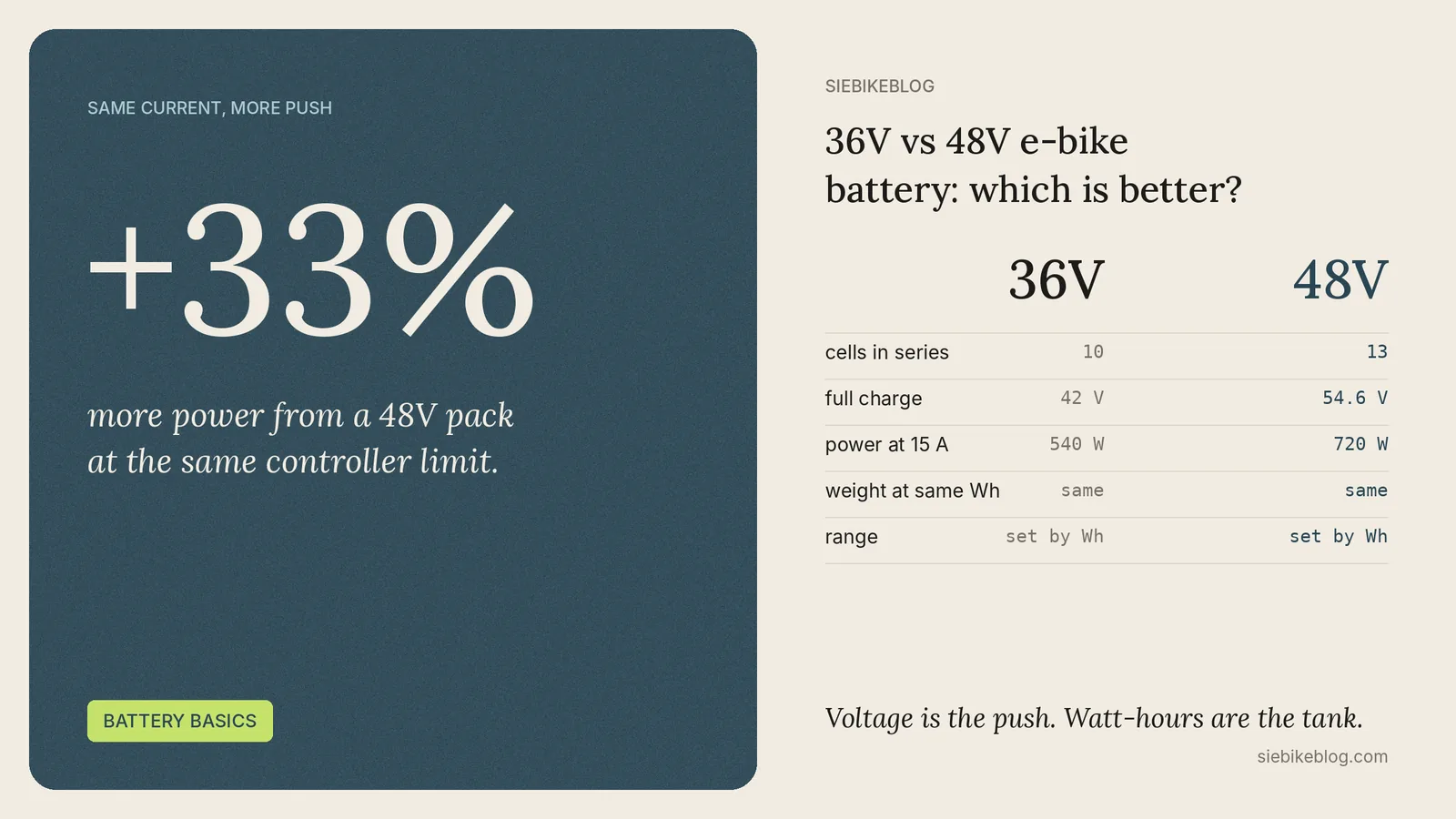
Quick Answer: 36V vs 48V e-bike battery: which is better? A 48V system delivers more power from the same current, so it feels stronger on hills and with heavy loads. A 36V system suits lighter bikes and flat commutes. Range depends on watt-hours, not voltage, and you can’t swap one for the other on the same bike.
Key Takeaways
- With the same controller current limit, a 48V system delivers a third more power than 36V.
- At equal watt-hours, a 36V and a 48V pack weigh about the same and hold the same energy.
- 48V draws less current for the same power, so wiring and controller run a little cooler and lose less energy as heat.
- Legal speed limits, not battery voltage, cap how fast most e-bikes go on motor power.
- Never fit a 48V battery to a 36V bike, or the reverse, unless the motor, controller and charger are rated for it.
Voltage is the first number on most e-bike battery labels, and it’s easy to assume higher is simply better. It isn’t that simple. Voltage changes how the bike feels under load, but it doesn’t decide range, and it locks you into matching parts.
This guide compares 36V and 48V side by side, explains what really changes on hills and on the open road, clears up common myths about weight and range, and shows which one fits the way you ride.
Table of Contents
- 36V vs 48V at a glance
- Is a 48V e-bike more powerful and faster?
- Does a 48V battery give more range?
- Can you put a 48V battery on a 36V e-bike?
- Which should you choose?
- Frequently asked questions
36V vs 48V E-Bike Battery at a Glance
The core difference is how many cells sit in series. Battery University explains that adding cells in a string raises a pack’s voltage while its capacity in Ah stays the same. A “36V” pack has 10 cells in series; a “48V” pack has 13.
| 36V battery | 48V battery | |
|---|---|---|
| Cells in series | 10 | 13 |
| Voltage when full | about 42 V | about 54.6 V |
| Power at a 15 A controller limit | about 540 W | about 720 W |
| Current needed for 500 W | about 13.9 A | about 10.4 A |
| Typical use | City, folding and lighter commuter bikes | Fat-tire, cargo, hilly-terrain and higher-power bikes |
| Weight and cost at the same Wh | About the same | About the same |
| Range | Set by Wh, not voltage | Set by Wh, not voltage |
Power figures are volts × amps using nominal voltage; real output depends on the motor and controller.
The last two rows surprise most riders. A 48V pack only weighs and costs more when it also holds more energy. The basics of Ah and Wh are covered in our guide to what Ah means on an e-bike battery; here, the question is what voltage itself changes on the road.
Is a 48V E-Bike More Powerful and Faster?
More powerful under load, yes. Faster, only up to the legal limit. The difference comes from a simple rule: power equals volts times amps.
Power (W) = Voltage (V) × Current (A)
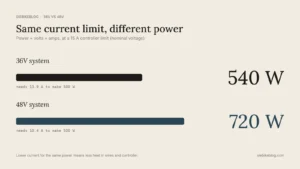
At the same current, the 48V system delivers about a third more power.
Why 48V feels stronger on hills
Every e-bike controller has a maximum current it allows. At the same limit, a 48V system pushes about a third more power into the motor than a 36V system. You feel that extra push when you set off from a stop, climb a steep hill, or carry a child seat or cargo.
Why 48V isn’t always faster
On the same motor, a higher voltage lets the motor spin faster. But the law usually caps motor-assisted speed. In the US, federal law defines a low-speed electric bicycle as having a motor under 750 W and a top motor-only speed under 20 mph, and many states add class rules on top. In the EU, pedal-assist stops at 25 km/h. A legal 36V and 48V bike in the same class reach the same assisted top speed; the 48V bike just gets there with less effort on hills.
Running cooler for the same power
At 500 W, a 36V system draws about 13.9 A while a 48V system draws about 10.4 A. Heat lost in wires and the controller rises with the square of current, so the 48V system loses roughly 44% less energy as heat in those parts at the same power. That’s a modest gain in efficiency, and a real gain in how hard the electronics work on long climbs.
Does a 48V Battery Give More Range?
Not by itself. Range depends on watt-hours (Wh), and a 36V pack can hold just as many as a 48V pack. Compare these two:
| Battery | Energy | Expected range |
|---|---|---|
| 36V 14Ah | 504 Wh | about 25–40 miles |
| 48V 10.5Ah | 504 Wh | about 25–40 miles, slightly more on hilly routes |
| 48V 14Ah | 672 Wh | about 34–56 miles |
Estimates at 12–20 Wh per mile on mixed riding, the same basis used across SieBikeBlog’s battery guides.
The first two batteries store the same energy and give about the same range. The 48V pack may squeeze out a little more on long climbs, because it loses less energy as heat at high power. Most of the range difference people notice comes from the third row: 48V bikes are often sold with bigger batteries.
So when you compare two bikes, compare Wh first. Our e-bike range calculator can help you estimate range for your own battery and rides.
Battery lifespan works the same way. Cycle life depends on cell quality, heat and charging habits rather than voltage, as covered in our guide on how long an e-bike battery lasts.
Can You Put a 48V Battery on a 36V E-Bike?
No, not unless every part of the system is rated for 48V. Voltage has to match across the battery, controller, motor, display and charger.
| Swap | What happens | Verdict |
|---|---|---|
| 48V battery on a 36V bike | The 36V controller and display can be over-stressed by up to 54.6 V; parts may fail, and the warranty is void | Don’t, unless the controller and motor are confirmed 48V-rated |
| 36V battery on a 48V bike | The controller sees a voltage below its low-voltage cut-off and won’t run, or cuts out right away | Won’t work |
| 36V charger on a 48V battery (or the reverse) | The battery is undercharged, or dangerously overcharged | Never |
Some aftermarket controllers accept a range of voltages, and some conversion kits are sold as 36V/48V compatible. If you’re considering an upgrade, check the voltage rating printed on the controller and display, and ask your bike’s brand or a qualified shop first. On branded systems such as those from major mid-drive makers, the battery, motor and charger are designed as a matched set, so stay within that system.
The safest upgrade path for more range is a higher-Ah battery at your bike’s existing voltage. If a charger mismatch is why your battery won’t fill up, see our guide on why an e-bike battery won’t charge.
Which Should You Choose: 36V or 48V?
Choose by how and where you ride. Here’s a quick guide:
| If you… | Choose | Why |
|---|---|---|
| Commute on mostly flat roads | 36V | Plenty of power for the legal speed limit; often lighter, cheaper bikes |
| Want a light folding or city bike | 36V | Many small, light e-bikes use 36V systems |
| Ride steep hills every day | 48V | More power at the same current for climbs |
| Carry kids, cargo or weigh over about 100 kg | 48V | Extra power for heavy loads and starts from a stop |
| Ride a fat-tire or off-road bike | 48V | Wide tires and rough ground need more power |
| Want the most range | Either | Pick the bike with the most Wh, not the highest voltage |
If you’re between the two, test-ride both on a hill near you. The difference is easiest to feel when the bike is working hardest.
A 52V battery takes the same idea one step further, with 14 cells in series and about 58.8 V when full. It’s mostly found on performance and DIY builds, and it needs a 52V-rated controller just like the 48V swap above.
Frequently Asked Questions
Is 48V better than 36V for an e-bike? For hills and heavy loads, yes. For light bikes and flat commutes, 36V is enough. Neither is better for range on its own; that depends on Wh.
How fast is a 36V e-bike compared with a 48V? On legal e-bikes, both reach the same assisted top speed for their class. A 48V bike gets there more easily on hills and with heavy loads.
Is a 48V battery heavier than a 36V battery? Only if it stores more energy. At the same Wh, the number of cells is the same, so the weight is about the same.
Can I charge a 48V battery with a 36V charger? No. It won’t charge the battery properly. Always use the charger made for your battery’s voltage.
Do 48V batteries last longer? Not because of voltage. Lifespan depends on cell quality, charge cycles, heat and how you store the battery.
Is a 48V e-bike legal? In most places, yes. E-bike laws limit motor power and speed rather than battery voltage, so a 48V bike within its class’s limits is generally legal. Check your local rules.
The Bottom Line
In the 36V vs 48V e-bike battery choice, 48V gives more power for hills, cargo and heavy riders, while 36V suits lighter bikes and flat commutes. Compare range in watt-hours, and stick to your bike’s original voltage when you replace a battery.


Leave a Reply