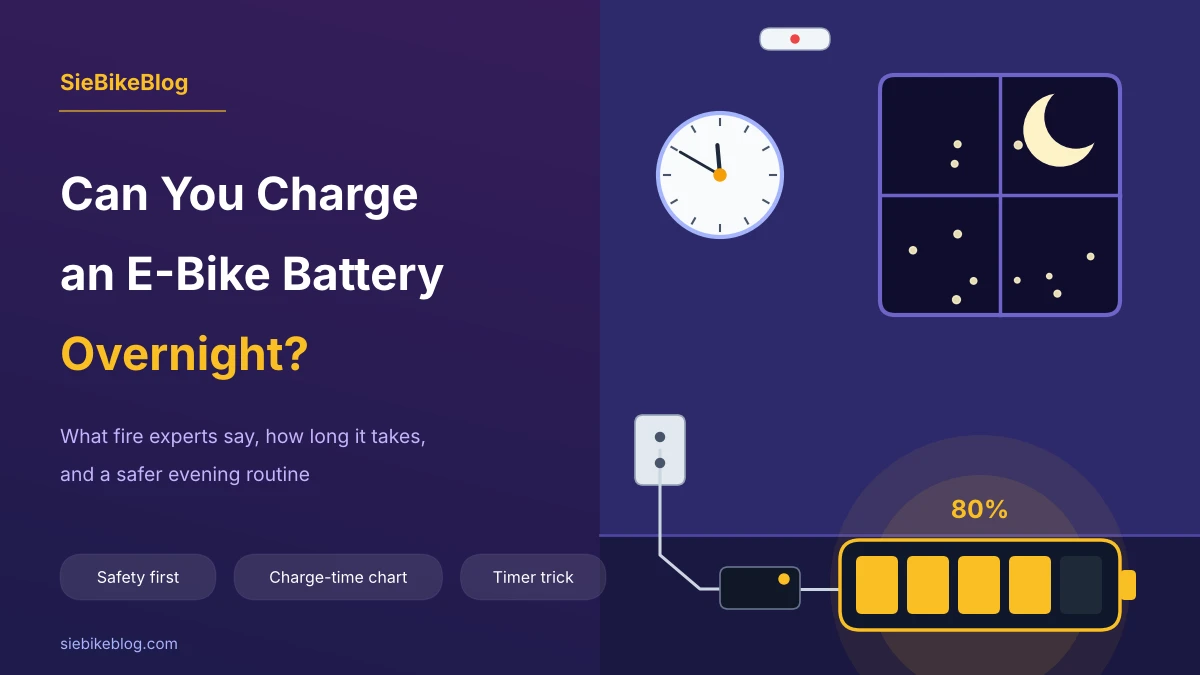
Quick Answer: You can, but you shouldn’t make it a habit. A modern charger stops at 100%, so the battery won’t overcharge. The bigger issues are fire safety and battery wear: the FDNY advises never charging e-bike batteries overnight or unattended, and a pack left sitting at 100% ages faster.
Key Takeaways
- “Overcharging” is mostly a myth with a working charger. Lithium-ion chargers cut the current when the pack is full.
- The real overnight risk is a fault no one is awake to notice, such as a damaged cell or a faulty charger.
- A standard 2A charger needs roughly 7 hours to fill a 500 Wh pack, which is why so many riders plug in before bed.
- An inexpensive smart plug with a timer lets you charge while you’re home and awake, and stop near 80%.
- Charge on a hard surface, away from exits and anything flammable, with a working smoke alarm nearby.
Charging an e-bike battery overnight feels like the obvious routine: plug in before bed, wake up to a full pack. Most of the time nothing goes wrong. But “most of the time” is the problem, and fire departments take a much firmer line than e-bike brands do.
This guide explains what happens inside the battery once it’s full, why safety agencies still say no, how long your battery needs to charge, and a simple evening routine that gets you a ready-to-ride battery without the overnight risk.
Table of Contents
- Does an e-bike battery stop charging when it’s full?
- Why do fire departments say not to charge overnight?
- How long does an e-bike battery take to charge?
- How do you charge safely without leaving it overnight?
- When should you stop charging immediately?
- Frequently asked questions
Does an E-Bike Battery Stop Charging When It’s Full?
Yes. A working lithium-ion charger cuts the current once the battery reaches full voltage, so leaving it plugged in won’t push more energy into the cells. Lithium-ion can’t safely absorb extra charge, which is why chargers are designed to stop rather than trickle.
Battery University’s guide to charging lithium-ion describes the two stages every e-bike charger follows:
- Constant current (bulk stage): the charger pushes a steady current until the pack reaches its voltage limit. This fills roughly the first 70–85% and takes most of the charging time.
- Saturation (top-off stage): voltage holds steady while the current tapers off. When it drops to a few percent of the battery’s rating, the charger switches off. Some chargers then add a short top-up charge if the voltage sags later.
Inside the pack, the battery management system (BMS) adds a second layer of protection. It watches each cell group’s voltage and temperature and disconnects the pack if something goes outside safe limits.
So why do people still worry? Two reasons. First, a full battery left at peak voltage for hours ages faster; Battery University advises keeping time at the peak cut-off as short as possible. That’s the same wear pattern covered in our guide on how long an e-bike battery lasts, where a pack stored at 100% for a year lost five times more capacity than one kept near 40%. Second, every safeguard assumes the charger, BMS and cells are working properly. That assumption is where fire departments draw the line.
Why Do Fire Departments Say Not to Charge Overnight?
Because a battery fire that starts while you’re asleep gives you far less time to react. The FDNY’s lithium-ion battery safety sheet tells riders never to leave a battery charging overnight and never to leave an e-bike unattended while it charges.
The concern isn’t that a normal charge cycle is dangerous. It’s that the rare failure, when it happens, moves fast:
- A damaged cell can overheat on its own. A drop, a crash or water getting into the pack can damage a cell without any visible sign. Charging adds heat and current to that weak spot.
- Uncertified or mismatched chargers may skip safety cut-offs. The FDNY specifically warns against aftermarket and generic batteries and chargers.
- Lithium-ion fires are hard to put out. The same FDNY sheet notes that standard fire extinguishers don’t work on them, and a battery can keep generating heat even after flames stop.
Where you charge matters as much as when. The FDNY advises charging away from anything flammable and heat sources, never on a bed or couch, never through a power strip, and never in a spot that blocks the main way out of a room. A hallway by the front door is one of the worst places to charge, even though it’s often the most convenient.
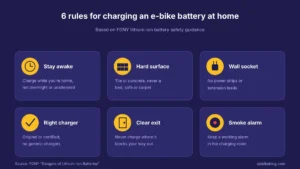
Where you charge matters as much as how long you charge.
None of this means your battery is likely to catch fire. Certified packs from reputable brands fail rarely. The point is that if a fault does happen, you want to be awake, nearby and able to unplug it. That makes charge time the next thing to work out.
How Long Does an E-Bike Battery Take to Charge?
Most e-bike batteries take 3.5 to 10 hours to charge from empty, depending on battery size and charger strength. You can estimate your own time with one line:
Hours to full ≈ Battery Wh ÷ Charger watts + about 1 hour for the top-off stage
Charger watts equal the charger’s output voltage times its amps, both printed on the charger label. A typical 36V system charger outputs about 42V, so a 2A model delivers roughly 84 W and a 4A model about 168 W.
| Battery size | 2A charger (~84 W) | 4A charger (~168 W) |
|---|---|---|
| 400 Wh | about 6 hours | about 3.5 hours |
| 500 Wh | about 7 hours | about 4 hours |
| 625 Wh | about 8.5 hours | about 4.5 hours |
| 750 Wh | about 10 hours | about 5.5 hours |
Estimates from empty to full for a 36V system, using the formula above. A 48V charger at the same amps delivers more watts and finishes sooner. Cold batteries and older packs charge more slowly.
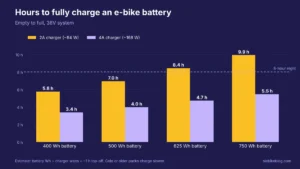
Large batteries on a basic 2A charger need most of a night to reach 100%.
Two things stand out. A big battery on a basic 2A charger needs most of a night, so it’s easy to see why overnight charging became the default. And the last hour or so only adds the final 15–30%, because current tapers in the top-off stage. If you stop at 80–90%, you skip most of that slow tail and finish much sooner.
That’s the key to a safer routine: you rarely need the full charge time, and you rarely need to charge from empty.
How Do You Charge Safely Without Leaving It Overnight?
Charge in the evening while you’re home and awake, and let a timer stop it before you go to bed. This keeps someone nearby during charging and avoids hours at 100%.
A simple evening routine
- Let the battery cool after your ride. Wait about 30 minutes if it feels warm.
- Charge in the right spot. Use a hard, non-flammable surface such as a tiled floor, away from beds, sofas, curtains and the room’s exit. Make sure a smoke alarm works in that room.
- Plug the charger straight into a wall socket. Skip power strips and extension leads.
- Use the original or a certified charger. Look for a UL, CE or equivalent mark that matches your battery’s brand and voltage.
- Set a timer and unplug before bed. If the pack still needs more, finish the top-up in the morning before you ride.
Worked example: setting a smart plug timer
A smart plug or a basic mechanical outlet timer can switch the charger off for you. To set it, work out how long you need for the charge you want, not for a full charge:
Hours needed ≈ (Target % − Current %) × Battery Wh ÷ Charger watts
- Your 500 Wh battery shows 30% after the commute, and you want 80%.
- 50% of 500 Wh = 250 Wh to add.
- With a 2A charger (~84 W): 250 ÷ 84 ≈ 3 hours. With a 4A charger (~168 W): about 1.5 hours.
- Plug in at 6 p.m., set the timer for 3 hours, and charging stops at 9 p.m. while you’re still up.
This works well below 80–85% because charging is close to linear in the bulk stage. Check the battery’s charge display the first time, then adjust the timer by 15–30 minutes if needed.
If your bike’s app or display has a charge limit setting, use it as well. It does the same job without the arithmetic. Even with a good routine, though, you should know the signs that mean a battery should come off the charger at once.
When Should You Stop Charging Immediately?
Unplug the charger at the wall right away if the battery or charger shows any sign of trouble. The U.S. Fire Administration lists the warning signs to watch for:
- A strange or chemical smell
- The pack or charger getting hot, not just warm
- A swollen, bulging or cracked case
- Leaking fluid or a change in color
- Hissing, popping or crackling sounds
A normal charge leaves the pack slightly warm at most. Battery University suggests stopping if the temperature rises more than 10°C (18°F) during a normal-speed charge.
If you see smoke or flames, don’t try to put it out. Leave the room, close the door behind you and call the emergency services, as the FDNY advises. After any of these warning signs, have the battery checked by your dealer or the manufacturer before using it again.
Frequently Asked Questions
Is it safe to charge an e-bike battery in the garage? Yes, if the garage stays between 0°C and 40°C (32–105°F), has a smoke or heat alarm, and the battery sits away from fuel, paint and solvents. In freezing weather, bring the battery inside to charge.
Can I charge the battery while it’s still on the bike? Usually, if the manufacturer allows it. A removable battery gives you more choice of where to charge, which makes the safe-spot rules easier to follow.
Should I unplug the charger from the wall when I’m not using it? Yes. An idle charger still draws a little standby power, and unplugging it means nothing is live near the bike while you’re away.
Is it fine to charge after every ride? Yes. Lithium-ion batteries have no memory effect, so frequent partial top-ups are better for them than running the pack flat.
Does a faster charger harm the battery? A brand-approved fast charger is fine for regular use. Higher current mostly speeds up the first 70% or so; the final top-off takes about the same time either way.
Should I charge to 100% before a long ride? Yes, when you need the range. Time it so the battery finishes shortly before you leave, rather than sitting full for hours or days.
The Bottom Line
A modern e-bike battery won’t overcharge, but charging it overnight still leaves a rare fault unattended and keeps the pack at 100% for hours. Charge in the evening with a timer, stop around 80%, and unplug before you go to bed.

Leave a Reply