
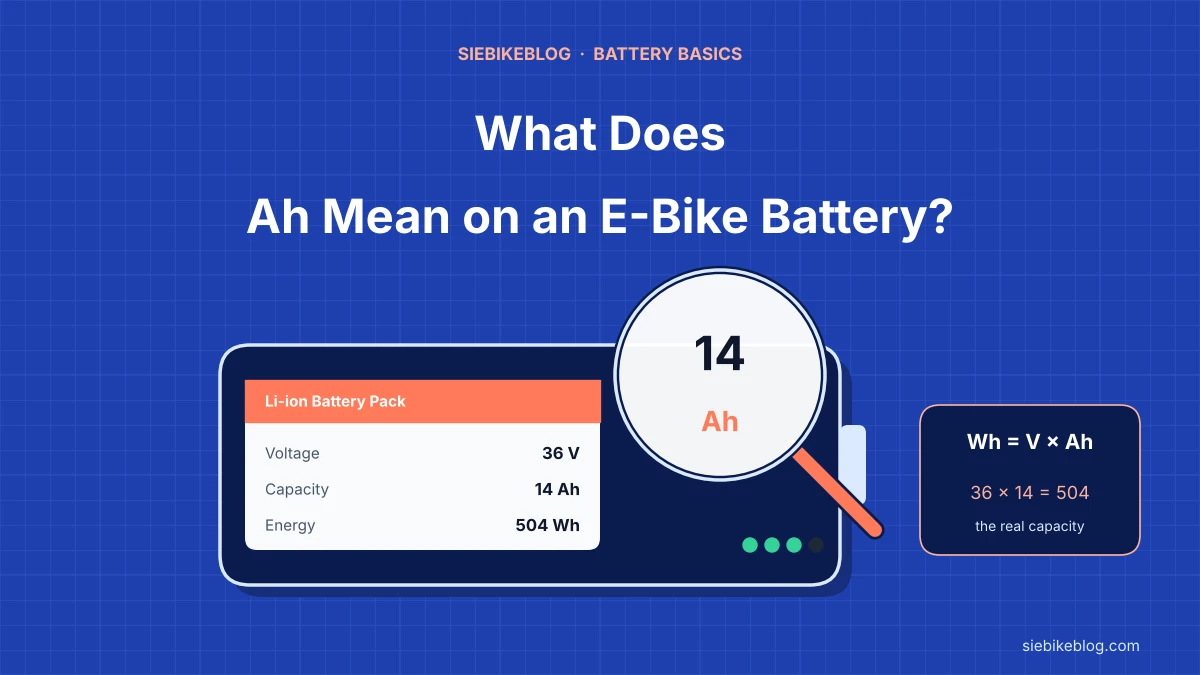
Quick Answer: What does Ah mean on an e-bike battery? Ah stands for amp-hours, a measure of how much electric charge the battery holds. A 14 Ah battery can supply 14 amps for one hour, or 7 amps for two. To compare batteries, multiply Ah by volts to get watt-hours (Wh), the true energy figure.
Key Takeaways
- Ah alone can mislead. A 48V 14Ah battery stores a third more energy than a 36V 14Ah battery.
- The formula is simple: Wh = V × Ah. Wh is the number that predicts range.
- On typical mixed riding an e-bike uses roughly 12–20 Wh per mile, so each Ah adds about 2–4 miles depending on voltage (an estimate).
- The “A” on a charger is a different number. It tells you charging speed, not capacity.
- A higher Ah only helps if the pack matches your bike’s voltage, connector and controller.
Open any e-bike spec sheet and you’ll see something like “36V 13.4Ah” or “48V 17.5Ah.” The Ah figure looks like the battery’s size, and it partly is. But shopping by Ah alone is one of the most common mistakes new riders make.
This guide explains what Ah measures, how it relates to volts and watt-hours, how to read a battery label, how far each Ah can take you, and why the amps on your charger mean something else entirely.
Table of Contents
- What does Ah measure?
- Ah vs Wh vs volts: which number matters?
- How do you read an e-bike battery label?
- How many miles does each Ah give you?
- Is a higher Ah battery always better?
- Is battery Ah the same as charger amps?
- Frequently asked questions
What Does Ah Measure on an E-Bike Battery?
Ah, or amp-hours, measures electric charge: how much current a battery can deliver, and for how long. Battery University’s battery definitions describe it as the discharge current a battery can supply over time.
The math is a simple trade-off between current and time:
- A 14 Ah battery can deliver 14 amps for 1 hour
- or 7 amps for 2 hours
- or 3.5 amps for 4 hours
In real riding the current changes every second, because current equals power divided by voltage. A motor drawing 150 W from a 36V pack pulls about 4 amps, while a 500 W climb pulls about 14 amps. The Ah rating is the total “tank” those draws come out of.
Inside the pack, Ah comes from how the cells are grouped. Cells wired side by side (in parallel) add their Ah together, while cells wired end to end (in series) add their voltage. A pack with four parallel groups of 3.5 Ah cells, for example, is rated about 14 Ah.
Ah is only half the story, though. It tells you how much charge the battery holds, not how much work that charge can do. For that, you need the voltage.
Ah vs Wh vs Volts: Which Number Matters Most?
Watt-hours (Wh) matter most, because they measure the battery’s total stored energy. You get Wh by multiplying the two numbers on the label:
Watt-hours (Wh) = Volts (V) × Amp-hours (Ah)
Here’s what each figure tells you:
| Spec | Unit | What it tells you | Use it to |
|---|---|---|---|
| Voltage | V | Electrical “pressure” of the pack | Check compatibility with your motor and controller |
| Amp-hours | Ah | How much charge the pack holds | Compare packs of the same voltage |
| Watt-hours | Wh | Total stored energy (V × Ah) | Compare range between any two packs |
The catch is that two batteries with the same Ah can store very different amounts of energy:
| Battery | Calculation | Energy |
|---|---|---|
| 36V 14Ah | 36 × 14 | 504 Wh |
| 48V 14Ah | 48 × 14 | 672 Wh |
| 52V 14Ah | 52 × 14 | 728 Wh |
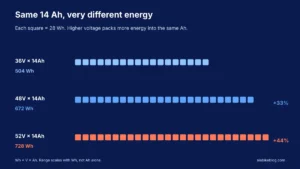
Same Ah, different energy: always compare batteries in watt-hours.
The 52V pack holds about 44% more energy than the 36V pack, even though all three say “14Ah.” That’s why Wh is the fair way to compare batteries, and why most spec sheets now list Wh next to Ah.
The voltage itself comes from cells in series. A lithium-ion cell has a nominal voltage of roughly 3.6–3.7 V and charges to about 4.2 V, the full-charge level cited by Battery University’s guide to prolonging lithium batteries. Ten cells in series make a “36V” pack that reaches about 42 V when full; thirteen make a “48V” pack; fourteen make a “52V” pack.
This is also why the math on real labels is sometimes slightly off. Retailers list the Bosch PowerTube 500 as 36 V and 13.4 Ah, which works out to 482 Wh, yet it’s sold as a 500 Wh battery. Brands often calculate with a slightly higher nominal cell voltage and round the result. Small gaps like this are normal; large ones are a red flag.
How Do You Read an E-Bike Battery Label?
Look for three numbers: volts (V), amp-hours (Ah) and watt-hours (Wh). Most labels on the battery case or in the manual show at least two of them, and you can work out the third.
- Find the voltage. Usually 36V, 48V or 52V on modern e-bikes. This number must match your bike’s system.
- Find the Ah. It may be written as “Ah,” “Capacity,” or occasionally in milliamp-hours (mAh); 14,000 mAh equals 14 Ah.
- Check or calculate the Wh. If Wh isn’t printed, multiply V × Ah. If it is printed, check that it roughly matches.
- Note any extras. Labels often show the cell maker, a safety certification mark (such as UL 2271 or CE), the charging voltage and a maximum discharge current.
If a label only shows Ah, convert it to Wh before you compare it with another pack. A “20Ah” battery at 36V (720 Wh) and a “15Ah” battery at 48V (720 Wh) store the same energy, even though one sounds bigger.
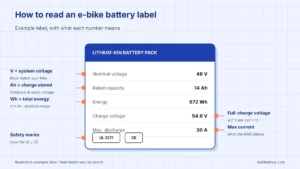
What each number on a typical e-bike battery label means.
How Many Miles Does Each Ah Give You?
Each amp-hour gives roughly 2 to 4 miles, depending on your battery’s voltage and how you ride. That range comes from a simple estimate: most e-bikes on mixed riding with moderate assist use about 12–20 Wh per mile, the same figure behind the range numbers in our guide on how long an e-bike battery lasts.
Because 1 Ah holds more energy at a higher voltage, the miles per Ah change with the pack:
| Battery voltage | Energy in 1 Ah | Miles per Ah (efficient riding, ~12 Wh/mile) | Miles per Ah (harder riding, ~20 Wh/mile) |
|---|---|---|---|
| 36V | 36 Wh | about 3 | about 1.8 |
| 48V | 48 Wh | about 4 | about 2.4 |
| 52V | 52 Wh | about 4.3 | about 2.6 |
Estimates. Hills, headwinds, heavy loads, throttle use, cold weather and tire pressure can push consumption well above 20 Wh per mile.
Worked example: estimating your range
Range (miles) ≈ Volts × Ah ÷ Wh per mile
- Your battery is 48V 14Ah, so it holds 48 × 14 = 672 Wh.
- On flat roads in eco mode you use about 12 Wh per mile: 672 ÷ 12 ≈ 56 miles.
- On hilly roads in a high assist mode you use about 20 Wh per mile: 672 ÷ 20 ≈ 34 miles.
To find your own Wh per mile, fully charge the battery, ride your usual route, and divide the Wh you used by the miles you rode. Most displays show battery percentage, so 50% used on a 672 Wh pack equals 336 Wh. Once you know that number, you can predict the range of any battery you’re thinking of buying.
Is a Higher Ah Battery Always Better?
No. A higher Ah gives more range only when everything else stays the same, and it brings trade-offs. Before you upgrade, check these four things.
It must match your bike’s voltage
A 48V battery on a 36V system can damage the controller and motor, and a 36V pack on a 48V bike won’t run properly. Choose a higher Ah at the same voltage, with the same connector and mounting, ideally from your bike’s brand.
More Ah means more weight and cost
Extra Ah means extra cells. Going from 14 Ah to 20 Ah at the same voltage adds roughly 40% more cells, so the pack gets heavier, larger and pricier. If your longest ride uses half your current battery, a bigger pack mostly adds weight.
Cell quality matters more than the number
Two “17.5Ah” packs can perform very differently. Packs built from known cell makers with a good battery management system (BMS) hold their rated capacity longer and handle high current better. Very cheap packs sometimes overstate Ah, so a suspiciously high number at a low price deserves a second look.
More Ah is gentler on the battery
There is one hidden benefit. A bigger pack covers the same ride with a shallower discharge, and shallow cycles wear lithium-ion cells more slowly, as explained in our battery lifespan guide. A larger battery can therefore last more years as well as more miles.
If you’re replacing a battery rather than upgrading, look for a certified pack such as UL 2271 or UL 2849 rather than the highest Ah you can find.
Is Battery Ah the Same as Charger Amps?
No. The battery’s Ah is how much charge it holds; the charger’s amps (A) is how fast it refills it. A “2A” charger pushes about 2 amps into the battery, and a “4A” charger about 4.
The two numbers together give a rough charge time:
Bulk charge time (hours) ≈ Battery Ah ÷ Charger amps
A 13.4 Ah pack on a 2A charger needs about 6.7 hours for the main charge, and a little longer to top off. That’s close to the 7 hours shown in the charge-time table in our guide on charging an e-bike battery overnight.
The ratio between the two also tells you how hard you’re pushing the cells. Battery University calls it the C-rate: 1C means charging at a current equal to the Ah rating. A 2A charger on a 13.4 Ah pack is only about 0.15C, which is very gentle. Even a 4A charger stays around 0.3C. That’s why brand-approved fast chargers are fine for regular use, while unbranded “high-amp” chargers that don’t match your pack are not.
Frequently Asked Questions
Is 10Ah good for an e-bike? At 36V, 10 Ah is 360 Wh, enough for roughly 18–30 miles on mixed riding. It suits short commutes and lighter folding bikes, but longer rides need more.
What is a good Ah for an e-bike battery? There’s no single best number, because it depends on voltage. Aim for the Wh you need instead: about 400–500 Wh for daily commutes under 20 miles, and 600 Wh or more for long or hilly rides.
Is 20Ah better than 15Ah? At the same voltage, yes: 20 Ah stores a third more energy. Across different voltages, compare Wh, because a 48V 15Ah pack matches a 36V 20Ah pack.
Does a higher Ah make an e-bike faster? No. Speed depends mainly on voltage, motor power and legal speed limits. Higher Ah only extends how long you can ride.
What does mAh mean? Milliamp-hours: one thousandth of an amp-hour. Divide by 1,000 to get Ah, so 17,500 mAh equals 17.5 Ah.
Does Ah drop as the battery ages? Yes. Usable capacity fades with use and time, so an older 14 Ah pack may only deliver 10–11 Ah, which you notice as shorter range.
The Bottom Line
Ah tells you how much charge an e-bike battery holds, but Wh tells you how far it will take you. Multiply volts by amp-hours before you compare any two batteries, and only upgrade within your bike’s own voltage.


Leave a Reply