
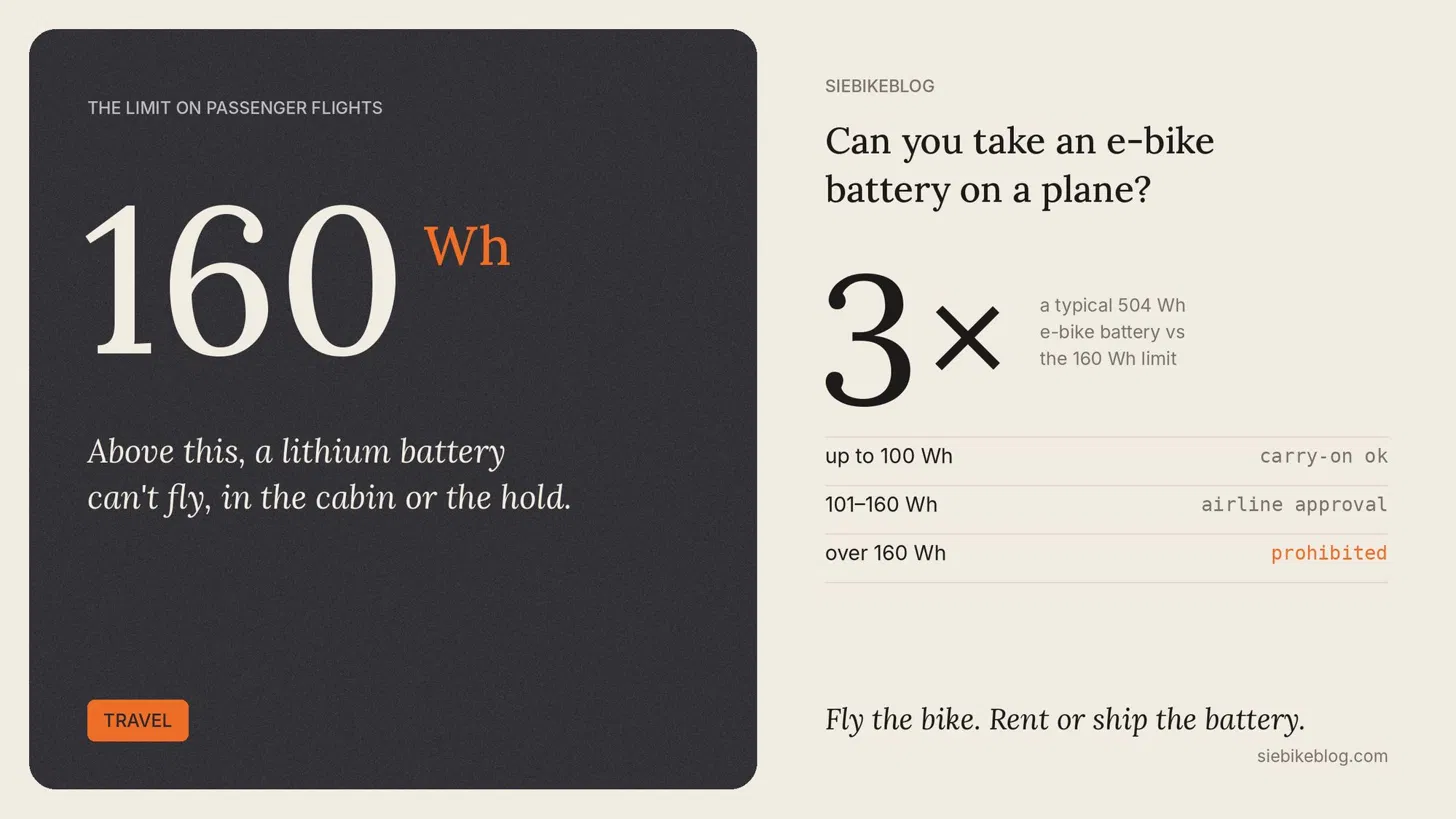
Quick Answer: Can you take an e-bike battery on a plane? Almost never. The FAA prohibits lithium-ion batteries over 160 Wh in both carry-on and checked bags, and most e-bike batteries hold several hundred Wh. You can usually fly with the bike if the battery is removed, then ship the battery separately or rent one at your destination.
Key Takeaways
- Under 100 Wh: generally allowed in carry-on. 101–160 Wh: only with airline approval. Over 160 Wh: prohibited.
- Work out your battery’s size with one sum: volts × amp-hours = watt-hours.
- A typical 36V 14Ah e-bike battery is 504 Wh, more than three times the 160 Wh limit.
- Many airlines accept an e-bike as sports equipment only with the battery removed; some refuse e-bikes entirely.
- Shipping a battery by ground counts as dangerous goods, so use a carrier’s approved service.
Planning a trip with your e-bike? The battery is the one part that almost always has to stay off the plane. That rule comes from aviation safety regulators, not individual airlines, so there’s little room for exceptions.
This guide shows the exact battery limits, how to check your own battery against them, whether you can fly with the bike frame, and the practical options for getting power at the other end.
Table of Contents
- What are the airline battery limits?
- How do you check your battery’s watt-hours?
- Can you fly with the e-bike without its battery?
- What are your options if the battery can’t fly?
- How do you ship an e-bike battery?
- Frequently asked questions
What Are the Airline Rules for Lithium-Ion Batteries?
The limits are set by battery size in watt-hours (Wh). The FAA’s guidance on portable devices powered by lithium-ion batteries says airline approval is needed above 100 Wh, and that a battery over 160 Wh “is prohibited as carry-on or checked baggage.” IATA’s traveler guidance uses the same thresholds for airlines worldwide.
| Battery size | Carry-on | Checked bag | Typical example |
|---|---|---|---|
| Up to 100 Wh | Generally allowed | Spares not allowed | Phone power bank, laptop battery |
| 101–160 Wh | Only with airline approval, up to 2 spares | Spares not allowed | Large camera or drone batteries |
| Over 160 Wh | Prohibited | Prohibited | Almost every e-bike battery |
Spare lithium batteries, meaning ones not installed in a device, must travel in the cabin, never in checked luggage. But that only matters for batteries under 160 Wh. An e-bike battery is above the limit in either place, so it can’t board a passenger flight at all.
Airlines can also set rules stricter than these, and some refuse battery-powered mobility and sports devices altogether. Always check your airline’s dangerous goods page before you book.
How Do You Check Your E-Bike Battery’s Watt-Hours?
Look for the Wh figure on the battery label. If only volts and amp-hours are printed, multiply them; the FAA uses the same method.
Watt-hours (Wh) = Volts (V) × Amp-hours (Ah)
| Battery | Calculation | Watt-hours | Compared with the 160 Wh limit |
|---|---|---|---|
| 36V 7Ah (small folding bike) | 36 × 7 | 252 Wh | about 1.6 times over |
| 36V 14Ah (typical commuter) | 36 × 14 | 504 Wh | about 3 times over |
| 48V 14Ah | 48 × 14 | 672 Wh | about 4 times over |
| 52V 17.5Ah | 52 × 17.5 | 910 Wh | about 5.7 times over |
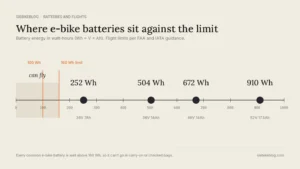
Even a small 36V folding-bike battery is well over the limit.
Even a small battery on a lightweight folding e-bike lands well above 160 Wh. To fit under the limit, a 36V pack would need to hold less than about 4.4 Ah, which would give only a few miles of assisted riding.
Never open a battery to split it into smaller packs. It’s dangerous, it voids the warranty, and a modified lithium pack is a fire risk in any luggage. If you’re unsure how to read your label, our guide to what Ah means on an e-bike battery walks through each number.
Can You Fly With the E-Bike Without Its Battery?
Often yes, but it depends on the airline. Many airlines treat a bicycle as sports equipment, and some will accept an e-bike in that category if the battery is fully removed. Others refuse e-bikes completely, battery or not, because staff can’t easily confirm that no battery is inside.
Before you book:
- Read the airline’s sporting-equipment and dangerous-goods pages. Search for “e-bike” or “electric bicycle” specifically, not just “bicycle.”
- Check whether your battery is removable. Bikes with batteries sealed inside the frame are much harder to fly with, because the battery can’t be taken out at the airport.
- Confirm weight and size limits. E-bikes are heavy, and many airlines charge extra or refuse bags above a set weight.
- Get the answer in writing. An email or chat transcript from the airline helps if check-in staff are unsure.
When you pack, remove the battery, tape over or cover the battery contacts on the frame, and pack the bike in a padded bike box or case. Carry a printout of the bike’s spec sheet showing that it has a removable battery, so staff can see what they’re looking at.
What Are Your Options If the Battery Can’t Fly?
You have four realistic choices. Which one is best depends on how long you’re staying and how much you value riding your own bike.
| Option | Best for | Watch out for |
|---|---|---|
| Rent an e-bike at your destination | Short trips, holidays | Less choice of bike size and model |
| Fly the bike, rent or borrow a compatible battery there | Riders with a popular motor system | Battery must match your system exactly; ask local dealers first |
| Fly the bike, ship your battery separately | Longer stays, special bikes | Dangerous-goods rules, cost and transit time |
| Ship the whole bike with its battery by ground | Moving home, long stays | Needs a carrier that accepts lithium batteries; plan weeks ahead |
For most trips, renting at the destination is the cheapest and least stressful option. If you ride a bike from a big motor brand, local dealers at your destination may be able to rent or sell you a compatible battery, so call ahead.
If you do take the bike, store the battery at home at around 30–60% charge while you’re away, as explained in our guide on how long an e-bike battery lasts. A battery left full for weeks ages faster.
How Do You Ship an E-Bike Battery?
Ship it by ground with a carrier that accepts lithium-ion batteries as dangerous goods. Large lithium-ion batteries are classed as hazardous materials for transport, so standard parcel services often refuse them or require a special account.
- Ask the bike brand or a local dealer first. Many shops ship batteries regularly and already have the right packaging and carrier account.
- Use the carrier’s dangerous-goods service. Tell the carrier exactly what you’re sending; never label a battery as something else.
- Charge to about 30% before shipping. That’s the level airlines require for lithium-ion batteries sent on their own as air cargo, and a sensible level for ground transport too.
- Use the original box or approved packaging. Protect the terminals from short circuits and stop the battery moving inside the box.
- Insure and track it. Allow extra days, as dangerous-goods shipments can be slower.
Only ship a battery that is undamaged. A swollen, dropped or water-damaged pack shouldn’t be shipped at all; see the warning signs in our guide on why an e-bike battery won’t charge.
Frequently Asked Questions
Can I take an e-bike battery in checked luggage? No. Spare lithium batteries are banned from checked bags, and e-bike batteries also exceed the 160 Wh limit for the cabin.
What size battery can I take on a plane? Up to 100 Wh is generally allowed in carry-on. Between 101 and 160 Wh needs airline approval, with a maximum of two spares. Above 160 Wh is prohibited.
Can I take an e-bike on a plane if I remove the battery? Sometimes. Many airlines accept it as sports equipment once the battery is removed, but some ban e-bikes entirely, so check before booking.
Are e-bike batteries allowed on trains or ferries? Rules vary by operator and country. Some trains and ferries allow e-bikes with batteries fitted and others don’t, so check the operator’s policy before you travel.
Do the rules differ outside the US? The 100 Wh and 160 Wh thresholds follow international aviation rules, so they apply on most airlines worldwide. Individual airlines may be stricter.
Can I fly with an e-scooter or hoverboard battery instead? The same Wh limits apply. Many small devices are still over 160 Wh, and some airlines ban them regardless of size.
The Bottom Line
You can’t take an e-bike battery on a plane, because it’s far above the 160 Wh limit for passenger flights. Check your airline’s rules for flying the bike itself, and plan to rent, borrow or ship a battery for the other end.

Leave a Reply