

Quick Answer: How to tell if an e-bike battery is swollen: look for a bulging, cracked or warped case, seams or gaps that have opened up, a pack that rocks on a flat table, or a battery that no longer slides into its mount. A swollen battery is failing. Stop using and charging it, and contact the maker or a battery recycler.
Key Takeaways
- Most e-bike packs use rigid cylindrical cells, so swelling often shows as a distorted case or a poor fit rather than an obvious balloon.
- The London Fire Brigade calls a swollen or misshapen battery “a strong sign that it is failing.”
- Heat, a chemical smell, hissing or leaking are warning signs too, even without visible swelling.
- Never press, puncture, open or charge a swollen pack.
- Store it outside or in a non-flammable place away from your home’s exits until you can hand it in.
A swollen battery is one of the few e-bike problems you should treat as urgent. It means something inside the pack has gone wrong, and the cells may be producing gas. The good news is that the signs are easy to check in a few minutes with no tools.
This guide shows exactly what to look for, why batteries swell, what to do the moment you spot it, and how to stop it happening to your next battery.
Table of Contents
- What are the signs of a swollen e-bike battery?
- Why do e-bike batteries swell?
- What should you do if your battery is swollen?
- Can a swollen battery be fixed or still used?
- How can you prevent battery swelling?
- Frequently asked questions
What Are the Signs of a Swollen E-Bike Battery?
A swollen battery changes shape, and that change shows up in how the case looks and how the pack fits. The London Fire Brigade lists swelling, lumps, leaking and damage to the casing among the main warning signs of a failing e-bike battery.
Do this five-minute check with the battery switched off and unplugged:
- Look along the case in good light. Check every face for bulges, lumps, dents or a curved surface that used to be flat.
- Check the seams and end caps. Swelling pushes the case apart, so look for gaps, raised edges or split seams, especially where two halves of the case join.
- Do the table test. Lay the battery on a flat table. A healthy pack sits flat; a swollen one rocks or spins when you press gently on a corner.
- Test the fit. If the battery is suddenly hard to slide in or out of its mount, or the lock won’t close, the case may have grown.
- Use your other senses. Heat when idle, a sweet or chemical smell, hissing or crackling, or any leaking fluid are serious warning signs on their own.
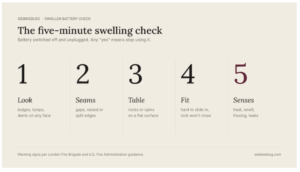
Any “yes” in these five checks means stop using the battery.
Why swelling can be hard to spot
Most e-bike batteries are built from cylindrical cells, the same shape as a thick AA battery, inside a rigid plastic or aluminium case. Cylindrical cells have strong metal cans, so they don’t puff up like a phone battery. Instead, a failing cell may push against the case from inside or vent gas, which you see as a warped case, a loose end cap or a pack that no longer fits. Some packs built from flat pouch cells can bulge more obviously.
If you notice any of these signs, stop here and go straight to the safety steps below.
Why Do E-Bike Batteries Swell?
Batteries swell when chemical reactions inside a damaged or stressed cell produce gas. The gas has nowhere to go, so it pushes the cell, and then the case, outward. These are the usual triggers:
| Cause | What happens inside | How it usually happens |
|---|---|---|
| Physical damage | A dented or crushed cell can short internally and heat up | A drop, a crash, or the bike falling on its battery side |
| Overcharging | Cells pushed past full voltage break down their electrolyte | A wrong or faulty charger, or a failed BMS |
| Heat | High temperature speeds up the reactions that create gas | Charging or storing in a hot car, direct sun or near a heater |
| Deep discharge | Cells left empty for months can be damaged internally | Long storage at 0% |
| Water | Moisture can corrode connections and cause shorts | Pressure washing, flooding, storage outdoors |
| Age and poor quality | Weak or mismatched cells fail first | Very old packs and cheap, uncertified batteries |
Often it’s a mix. A pack stored full in a hot garage for a summer, then dropped, has two strikes against it. The habits that slow normal ageing, such as moderate charge levels and room-temperature storage, are explained in our guide on how long an e-bike battery lasts, and they also lower the risk of swelling.
What Should You Do If Your E-Bike Battery Is Swollen?
Stop using it straight away and get it away from your living space. The London Fire Brigade advises stopping use, switching the device off, unplugging it and contacting the manufacturer or retailer as soon as warning signs appear.
- Unplug the charger at the wall. Don’t pull the battery off a hot charger with bare hands; switch off the socket first.
- Switch the battery off and don’t ride the bike. Even a short ride adds heat and vibration.
- Move it somewhere safe if it’s cool enough to touch. Outside on concrete or paving, away from doors, windows, cars and anything that can burn. A metal bucket or a bed of sand adds extra protection.
- Don’t press, puncture or open it. Squeezing a swollen pack can short the cells inside.
- Call the bike brand, dealer or a battery recycler. Explain that the pack is swollen; many have a specific process for damaged batteries.
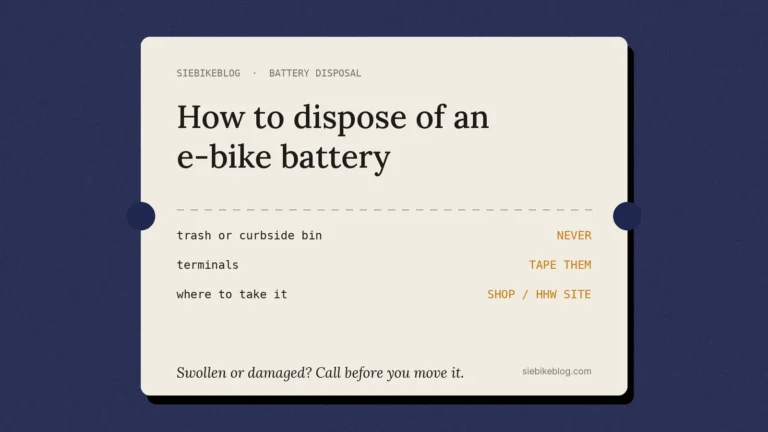
- Never put it in household rubbish or recycling bins. Damaged lithium batteries can start fires in bin lorries and waste sites.
If the battery is hissing, smoking, popping or on fire, don’t try to move it. Get everyone out, close the door behind you and call the emergency services. The U.S. Fire Administration also lists a change in shape, heat, odour, leaking and odd noises as reasons to stop using a lithium-ion battery.
Can a Swollen E-Bike Battery Be Fixed or Still Used?
No. Swelling means at least one cell is damaged, and the damage can’t be reversed. Here are the common myths:
| Myth | Reality |
|---|---|
| “It still works, so it’s fine.” | A swollen pack can keep working right up until it fails. Working is not the same as safe. |
| “I’ll just press it back into shape.” | Pressure can short the damaged cells and start a fire. |
| “I’ll let the gas out.” | Puncturing a lithium cell is one of the most dangerous things you can do to it. |
| “A shop can replace the bad cell.” | Specialist rebuilders sometimes recell old packs, but a swollen pack is usually rejected as unsafe to open. |
| “I’ll only charge it outside.” | Charging adds heat and current to the damaged cell; don’t charge it anywhere. |
| “It’s under warranty, so I’ll post it back.” | Damaged batteries need special shipping. Ask the maker for instructions before sending anything. |
The only safe path is replacement. Choose an original or certified pack (look for UL 2271 or UL 2849 on the label) with the same voltage as your bike. Our guide on 36V vs 48V e-bike batteries explains why the voltage has to match.
How Can You Prevent E-Bike Battery Swelling?
Most swelling comes from heat, damage or the wrong charger, so prevention is mostly about those three.
- Use the original or brand-approved charger. A mismatched charger can overcharge the cells. If your charger seems faulty, see our guide on why an e-bike battery won’t charge for how to test it.
- Keep it cool. Don’t charge or store the battery in direct sun, a hot car or next to a heater.
- Store it at a partial charge. For weeks or months off the bike, keep it around 30–60% rather than full or empty.
- Protect it from knocks. Lay the bike down on the side away from the battery, and remove the battery before transporting the bike on a car rack.
- Keep water out. Avoid pressure washers and store the bike under cover.
- Check it every month. Run the five-minute check above, especially after a drop or crash.
- Buy certified batteries. Cheap, uncertified packs are more likely to have weak cells and poor protection circuits.
Charging where and when it’s safe matters too. Our guide to charging an e-bike battery overnight covers the best spot and routine.
Frequently Asked Questions
Is a slightly swollen e-bike battery dangerous? Yes. Even slight swelling means a cell is damaged and producing gas. Stop using it and arrange a replacement.
Can a swollen battery explode? A damaged lithium-ion battery can overheat, vent hot gas and catch fire. That’s why you shouldn’t charge, ride or store it indoors.
How long can a swollen battery sit before it catches fire? There’s no safe waiting time. Some swollen packs stay stable for weeks; others fail quickly. Treat it as urgent.
Does the warranty cover a swollen battery? Often, if the swelling comes from a defect rather than a crash, water or the wrong charger. Photograph the pack and contact the brand before sending anything.
Why does my battery no longer fit in its mount? The case may have swollen or been bent in a drop. Don’t force it in; check it for swelling first.
Can heat alone make a battery swell? Yes, especially when the battery is also full. A pack left fully charged in a hot car is under heavy stress.
The Bottom Line
You can tell if an e-bike battery is swollen by checking for a bulging or split case, a pack that rocks on a table, or one that no longer fits its mount. If you see any of these, stop using it, move it somewhere safe outdoors and contact the maker or a battery recycler.

Leave a Reply